-
Official Websites of
-
MINISTRY OF
PLANTATION AND COMMODITIES -
No. 15, Level 5-13, Persiaran Perdana, Presint 2, 62654 Wilayah Persekutuan Putrajaya


INFO ARKIB ELEKTRONIK
- Details
- Hits: 522
PETALING JAYA: TSH Resources Bhdhttps://cdn.thestar.com.my/Themes/img/chart.png" width="18" height="18" />’s prospects remain promising, supported by steady crude palm oil (CPO) prices this year.
The plantation company – whose core net profit rose to RM22.7mil for the first quarter ended March 31, 2024 (1Q24) from RM3.6mil in 1Q23 – expects CPO prices to hold at current levels of RM3,500 to RM4,000.
This is on softer expectations of soybean crop production, it said.
Citing TSH management, TA Research said the company was cautiously optimistic about its 2024 financial performance, with CPO prices expected to be sustained at current levels due to the floods in southern Brazil.
The floods had tempered expectations for a strong soybean crop production.
“We anticipate that the movement of palm oil prices in the coming months will be influenced by both palm oil production in key producing countries (Malaysia and Indonesia) and weather patterns in the primary soybean-growing regions of Brazil and Argentina,” the brokerage said.
TA Research upgraded its call on TSH to a “buy” from a “sell” to reflect the increased upside potential and more promising outlook.
It also raised its target price for the counter to RM1.37, from RM1.14 previously, based on 18 times price-earnings ratio, after rolling forward the valuation base year to 2025.
Meanwhile, Kenanga Research maintained its “outperform” call on TSH, with an unchanged target price of RM1.30 based on 0.8 times price-to-book value.
The brokerage said TSH’s earnings were likely to remain firm over 2024-2025 on relatively steady CPO prices while production cost eases.
“CPO prices are expected to stay range bound, between RM3,500 and RM4,000 per tonne over 2024-2025.
“This is as global edible oil demand is expected to grow at 3% to 4% year-on-year, while the supply outlook may struggle to match.
“Thus, inventory is expected to stay flat or even dip slightly in 2024 and possibly into mid-2025,” Kenanga Research said.
“Input costs such as fertiliser and fuel have been easing since mid-2022 but could be bottoming of late.
“However, palm kernel prices could be picking up, helping to reduce CPO cost pressures than a year ago,” it added.
Kenanga Research said TSH would likely plant 8,000 to 10,000ha or expand its planted oil palm area by 20% to 25% over the next two to three years.
Hong Leong Investment Bank (HLIB) Research reiterated its “hold” call on TSH, with an unchanged target price of RM1.07.
“While we like TSH for its favourable age profile (average age of around 13 years) and improving balance sheet (net gearing of 0.01 times as at end-March 2024), further upside is capped by the absence of an earnings growth catalyst,” the brokerage explained.
It noted TSH was cautiously optimistic on its 2024 performance, which would be driven by stable CPO prices.
MIDF Research, which has maintained its “neutral” stance on TSH, has kept its target price for the counter at RM1.18.
“While TSH operates primarily as a pure upstream player with a strong correlation to CPO price movements, its share price does not necessarily reflect significant fluctuations.
“This is unless there are notable developments capable of influencing CPO prices above the RM4,500-per-tonne resistance level,” it explained.
https://www.thestar.com.my/business/business-news/2024/05/23/tsh-earnings-to-be-supported-by-steady-crude-palm-oil-prices
Sumber : The Star
- Details
- Hits: 2414
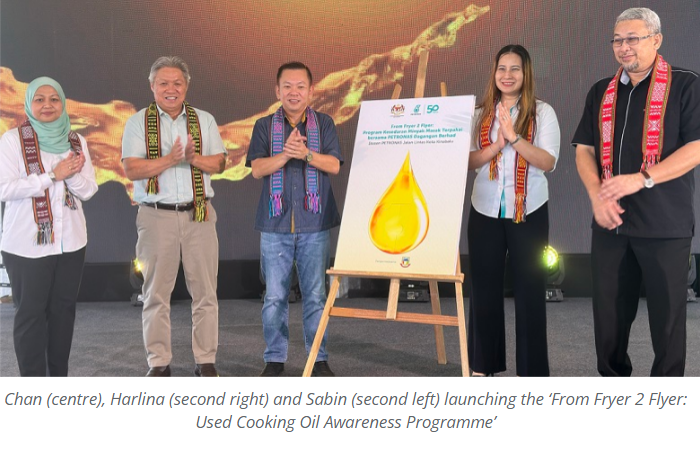
KOTA KINABALU (Aug 3): Used cooking oil (UCO) can now be sold to generate household income and produce sustainable aviation fuel (SAF) with the launching of the ‘From Fryer 2 Flyer: Used Cooking Oil Awareness Programme’ on Saturday.
The programme will also support the recycling agenda and reduce the rate of greenhouse gas emissions, in line with the country’s commitments to achieve net zero carbon emissions by 2025.
In this regard, Petronas Dagangan Berhad (PDB) has made several Petronas gas stations as UCO collection centres, to make it easier for people to send and sell their used cooking oil for RM2.50 per kilogram.
The nationwide initiative, which had started with only three Petronas gas stations around Klang Valley, has since expanded to 54 stations throughout the nation.
With this expansion, the Ministry of Plantation and Commodities (KPK) is targeting 500,000 kilogrammes of UCO to be collected and the participation of more than 100,000 people by end of this year.
In Sabah, three Petronas gas stations have been made as UCO collection centres, namely along Jalan Lintas in Kota Kinabalu, Batu 8 Labuk By-Pass in Sandakan and Jalan Utara in Tawau.
KPK Deputy Minister Datuk Chan Foong Hin, who officiated the State-level programme in collaboration with the Kota Kinabalu City Hall (DBKK) at the Petronas gas station along Jalan Lintas here on Saturday, said it will be expanded to other stations throughout the state.
Chan said his ministry protects the interests of the palm oil industry and small farmers through efforts to increase palm-oil based downstream products, in addition to supporting economic generation through a circular economy from palm oil biomass.
He said apart from raising awareness on economic and environmental benefits, organising such programmes will indirectly increase public awareness on the importance and direction of the palm oil and biofuel industries in Malaysia.
The deputy minister also suggested for a by-law to be enacted to obligate small traders and food hawkers around Kota Kinabalu to regularly manage their UCO by selling them to Petronas gas stations or UCO collection companies.
“Based on statistics from the Malaysian Palm Oil Board (MPOB), the amount of UCO collected in the state of Sabah is still low, which is only approximately 2,700 tonnes from January until June 2024.
“Overall, this amount does not even reach 1.5 percent of the total collection of UCO throughout Malaysia, which is around 200,000 tonnes in the same period.
“In addition, based on the MPOB survey, as much as 77 percent of the population do not recycle and throw away used cooking oil in the trash or less suitable ways.
“Through the organisation of today’s and future campaigns in Sabah, I hope that more Sabahans are aware of the importance of managing used cooking oil in the correct way.
“An increase in awareness among the general public will not only provide economic benefits to the people of this state, but also to the environment,” he said.
PDB General Manager, Strategy and Sustainability, Harlina Pikri said UCO is often thrown away, polluting the environment and clogging waterways.
Instead, she said these used cooking oil actually has great potential to be converted into biofuel, as through innovation and technology, the UCO collected from the nationwide initiative can be processed into cleaner fuel for airplanes or Sustainable Aviation Fuel (SAF).
Hence, she said the initiative will be an important milestone in reducing the aviation industry’s carbon footprint and bringing everyone one step closer to a more sustainable future.
“Since this initiative was launched last year, we have received a positive response from the community. To date, customers have received more than RM1 million in cashback! This not only eases their burden to some extent, but also shows the positive impact on the environment that we can achieve when all parties work together.
“Our goal is more stations so that more UCO can be collected, and more positive impact on the environment. It’s a win-win situation for everyone!
“We hope that with the expansion of this program, the culture of recycling used cooking oil will become easier and more beneficial, and we hope that we can continue to cooperate and achieve the goal of sustainable development,” she said.
Harlina added that Petronas is planning for the construction of an SAF refinery in Pengerang, Johor.
Also present was Kota Kinabalu Mayor Dato’ Sri Dr Sabin Samitah.
https://www.theborneopost.com/2024/08/03/used-cooking-oil-generates-income/
Sumber : The Borneo Post
- Details
- Hits: 304

KUALA LUMPUR, March 12 (Reuters) - Malaysian palm oil futures were largely unchanged on Tuesday as strength in Dalian edible oils wasoffset by a firmer ringgit and weak Chinese demand.
The benchmark palm oil contract FCPOc3 for May delivery on the Bursa Malaysia Derivatives Exchange closed up 2 ringgit, or 0.05%, to 4,133 ringgit ($884.06).
The contract was seen trading higher on supportive February output data in Malaysia as well as bullish momentum from Dalian vegetable oils futures, said Anilkumar Bagani, research head of Mumbai-based vegetable oils broker Sunvin Group.
"However, the stronger Malaysian ringgit and the absence of buying from key buyer China has capped the pace of the upside momentum in palm oil," Bagani said.
Dalian's most-active soyoil contract DBYcv1 rose 0.92%, while its palm oil contract DCPcv1 gained 1.08%. Soyoil prices on the Chicago Board of Trade BOcv1 were down 0.58%.
Palm oil is affected by price movements in related oils as they compete for a share in the global vegetable oils market.
Malaysia's palm oil stocks at the end of February dwindled to their lowest levels in seven months as production hit a 10-month low, offsetting the slowdown in exports.
Inventories at the end of February fell 5% from January to 1.92 million metric tons, crude palm oil production declined 10.18% to 1.26 million tons, while exports plunged 24.75%, data from industry regulator the Malaysian Palm Oil Board showed.
The Malaysian ringgit MYR=, palm's currency of trade, rose 0.13% against the dollar, making the commodity more expensive for buyers holding the foreign currency.
Exports of Malaysian palm oil products for March 1-10 rose 6.8% from the same period a month ago, cargo surveyor Intertek Testing Services said.
Another cargo surveyor, AmSpec Agri Malaysia, said exports during the same period rose 6.2% from a month ago.
($1 = 4.6750 ringgit)
https://www.nasdaq.com/articles/vegoils-palm-closes-almost-flat-as-firmer-ringgit-offsets-stronger-dalian-rival-oils
Sumber : Nasdaq
- Details
- Hits: 438

Let’s talk about something super important and totally cool: sustainable palm oil. Yes, you heard it right! You might wonder why this is a big deal and why we should care. Well, let’s dive into why supporting Malaysian sustainable palm oil is a win-win and why the #MYPalmPride campaign is the ultimate hype we need.
What’s the deal with palm oil?
Palm oil is everywhere– from your favourite snacks to your go-to skincare products.
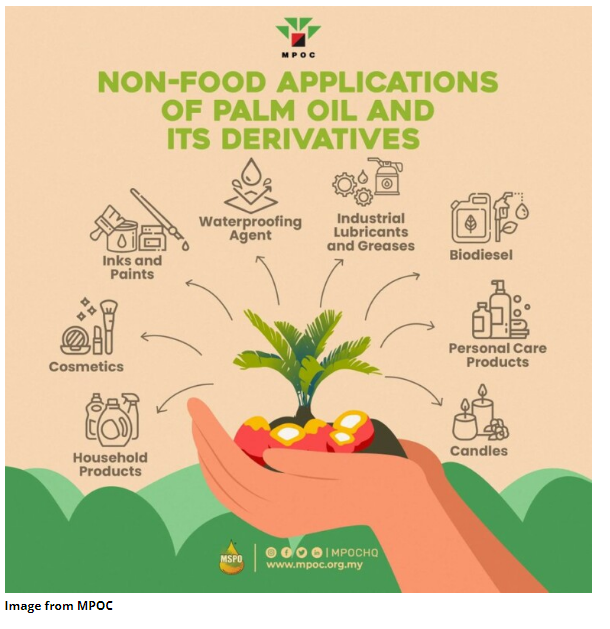
It’s a big part of our lives and a major player in Malaysia’s economy. But here’s the catch: traditional palm oil production has a bad rep for hurting the environment. That’s where sustainable palm oil steps in to save the day!
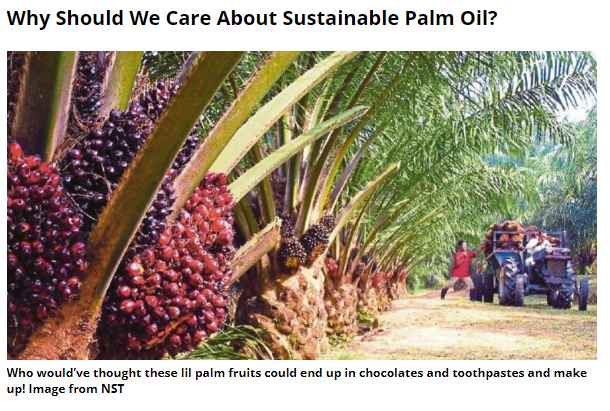
Save the planet, one palm at a time: By supporting sustainable palm oil, we help protect our beautiful rainforests and wildlife. Sustainable practices mean less deforestation and more love for Mother Earth.
Secure our future: Palm oil creates millions of jobs in Malaysia. Sustainable palm oil ensures that these jobs stick around for the long haul. So, by backing it, we’re making sure there are cool job opportunities for us and future generations.
Show the world what we’re made of: When we champion sustainable palm oil, we’re telling the world that Malaysia is a leader in eco-friendly practices. It’s a pride thing– we can show off our commitment to the environment and ethical production.
The #MYPalmPride Campaign: Why It Rocks
Spreading the word: #MYPalmPride is all about making sustainable palm oil the talk of the town. Through social media, fun contests, and cool content, it’s getting the word out there. The more people know, the bigger the impact!
Youth driven: This campaign is powered by Malaysian youths, both at home and abroad, taking the lead. It empowers young minds to take bold action, debunk myths, and raise peer-to-peer awareness, driving a positive impact on sustainable palm oil. With over 15 passionate advocates behind this movement, it paves the way for achieving even greater goals.
National pride vibes: This campaign taps into our love for Malaysia. It’s about taking pride in our country’s sustainable efforts and being part of something bigger. Plus, it’s super cool to say we’re leading the charge for a greener future.
Smart choices made easy: #MYPalmPride helps us make better choices. By highlighting products with the Malaysian Sustainable Palm Oil (MSPO) certification, it makes it easy to support sustainable options. Shopping with a cause? Yes, please!
How to Join the #MYPalmPride Movement
Learn and share via digital platforms: Get clued up on what sustainable palm oil is all about. Share the knowledge with your friends, family, and followers. The more we know, the more we grow!
Choose wisely: Look out for the MSPO certification when you’re shopping. Your choices can drive demand for sustainable products and make a real difference.
Get social: Use your social media platforms to spread the #MYPalmPride message. Post, tweet, and create content that highlights the importance of sustainable palm oil.
Be Active: Join #MYPalmPride contest, events, participate in sustainability initiatives, and get involved in community efforts. Your actions can inspire others to jump on the sustainability bandwagon.

Launched by REGENERASI on March 1st, the #MYPalmPride campaign is revolutionizing how we support Malaysian sustainable palm oil, making it both fun and accessible. This isn’t just a trend– it’s a powerful movement dedicated to saving our planet, securing our future, and showcasing our national pride. The Youth Council of REGENERASI and MASCA are making an inspiring visit to the Consulate-General of Malaysia, Perth Western Australia for a courtesy call with the Consul-General, proudly championing the #MYPALMPRIDE campaign in Western Australia.
Together, we can make sustainable palm oil the new cool. Let’s lead the charge!
https://cilisos.my/sustainable-palm-oil-mypalmpride-2/?amp
Sumber : Cilisos.my
- Details
- Hits: 386
Singapore's Wilmar International said on Tuesday its Chinese unit Yihai Kerry Arawana Holdings had denied involvement in an alleged China palm oil fraud.
The announcement followed a Jan. 12 stock exchange filing by Yihai Kerry denying allegations that one of its subsidiaries was partially accountable for a fraud that led to a loss of 5.2 billion yuan (US$725.13 million) for a state-owned enterprise.
Prosecution alleged that fake documents had been used to secure palm oil deliveries without paying full amount, according to the filing.
Yihai Kerry categorically denied any involvement and maintained that all transactions conducted by its unit adhered to contractual agreements. - Reuters
https://www.nst.com.my/business/corporate/2024/01/1001776/wilmar-unit-denies-involvement-alleged-china-palm-oil-fraud
Sumber : New Straits Times