-
Official Websites of
-
MINISTRY OF
PLANTATION AND COMMODITIES -
No. 15, Level 5-13, Persiaran Perdana, Presint 2, 62654 Wilayah Persekutuan Putrajaya


INFO ARKIB ELEKTRONIK
- Details
- Hits: 1059

KOTA KINABALU: Sabah is capable of contributing more to biomass and biofuel development, says Deputy Plantations and Commodities Minister Datuk Chan Foong Hin.
“However, due to low awareness, we are among the lowest contributors of used cooking oil (UCO) in the country,” he said during the Fryer 2 Flyer campaign here Saturday (Aug 3).
Chan said to increase participation among users in recycling used cooking oil for the purpose of sustainability, recycling and lowering greenhouse gas emissions, PETRONAS Dagangan Berhad (PDB) had in July last year launched its “Fryer 2 Flyer” campaign where selected gas stations collect UCO.
This campaign is a joint effort with the Plantations and Commodities Ministry.
Those who bring their UCO are paid RM2.50 per kg in Sabah, said Chan, adding that this price is lower than those in the peninsula because Sabah still enjoys subsidies on oil and fuel.
He said similar to the City Hall’s recent plastic bag reduction campaign beginning Aug 1, it is also hoped that a by-law for used cooking oil can be introduced.
“The City Hall is considering enacting a by-law for plastic bag usage, right? So I think they can also consider a by-law for used cooking oil disposal and recycling so that we can work better towards a low carbon city status for Kota Kinabalu,” he said.
For PETRONAS, the collected UCO can be turned into sustainable aviation fuel (SAF) while City Hall, as the partner for this campaign, will act as the movers for sustainable living in the city, said Chan.
The value of SAF is three times higher than normal aviation fuel price.
He said PETRONAS is targeting to collect some 500,000kg of UCO with the participation of over 100,000 users nationwide by year-end.
In Sabah, there are only two other Petronas fuel stations that offer UCO collection - Jalan Utara Tawau and Batu 8 Labuk, Sandakan, and these collection counters only open on Sundays.
https://www.thestar.com.my/news/nation/2024/08/03/sabah-has-potential-to-boost-biomass-and-biofuel-development-says-deputy-commodities-minister
Sumber : The Star
- Details
- Hits: 624

KOTA KINABALU: Sabah's palm oil industry needs to urgently expand its downstream sector to bridge the gap with counterparts in Peninsular Malaysia, says Datuk Chan Foong Hin.
The Deputy Plantation and Commodities Minister said that the ministry was committed to actively supporting Sabah's efforts to expand its downstream palm oil industry that will not only balance development but also increase revenue through value-added palm oil products.
In 2023, he said Sabah produced 4.5 million tonnes of crude palm oil, with 21.8% exported in crude form.
"This contrasts sharply with the peninsula's export rate of only 5.5% of crude palm oil, highlighting the substantial potential for Sabah's downstream palm oil industry growth," he said in a statement Tuesday (April 30).
Chan said a higher rate of crude palm oil exports results in less raw material available for downstream value-add or refining.
He said it was important for Sabah to diversify beyond upstream production and put in place a strong industry supply chain that maximises potential from upstream to downstream sectors to safeguard the sustainability of the palm oil industry.
Chan said this after a recent four-day tour of Sabah's east coast where he visited the Palm Oil Industrial Clusters (POIC) in Lahad Datu and Sandakan as well as met with two companies specialising in palm oil downstream activities.
The two companies were Mewah Datu Sdn Bhd, a subsidiary of Singapore's Mewah Group, and Gamalux Oils Sdn Bhd from Pakistan, both situated in POIC Lahad Datu.
He said the two POICs along Sabah's east coast played a pivotal role to drive the industrialisation efforts and become core centres for high-value palm oil and palm biomass downstream industries.
"Sabah's POICs offer comprehensive port and logistics infrastructure that can accelerate economic growth and industrial development.
"This makes it a highly appealing and promising investment destination.
"I am also excited to learn about Gamalux's plans for oleochemicals expansion in 2025, marking a significant milestone as the first unit in Malaysian Borneo. This event not only demonstrates Gamalux's ambitions but also its strong confidence in Lahad Datu as a growing hub for sustainable industrial development within the palm oil sector," said Chan.
https://www.thestar.com.my/news/nation/2024/04/30/sabah-must-push-for-expansion-of-downstream-palm-oil-sector-says-deputy-minister
Sumber : The Star
- Details
- Hits: 713
KOTA KINABALU: Sabah has reaffirmed its commitment toward the production of sustainable palm oil in the state by next year under a framework set by the Roundtable on Sustainable Palm Oil (RSPO).
It said it was on track to implement the Jurisdictional Approach Piloting Framework set by RSPO, currently the most recognised international certification for the production of sustainable palm oil.
Sabah’s efforts since 2015 were recognised at the RSPO’s annual conference in Jakarta, Indonesia.
The state achieved the first step of the four-step process last year.
This initiative is known as the Jurisdictional Approach to Sustainable Palm Oil (Jaspo).
A workshop was convened earlier this month to discuss the implementation of the second step.
Sabah Natural Resources Office secretary Sernam Singh said the next two years would entail the complete development and adoption of the framework.
“It will require a careful and unique approach to suit necessary solutions for complex issues in the state, ranging from labour issues to protection of high conservation value areas.
“Setting up mechanisms to achieve this will prepare Sabah for full compliance of national and international sustainability standards, including the European Union Deforestation Regulation,” he said
Sabah’s Chief Conservator of Forests Datuk Frederick Kugan said a landscape-based sustainability approach for the palm oil industry had been a groundbreaking journey as Sabah had shown its commitment and the ability to adapt to new challenges.
“The knowledge we have gained in the process is invaluable and will benefit not just Sabah’s palm oil industry but also other sectors and regions embarking on similar pursuits,” he added.
Sabah produces 24% of Malaysia’s production of crude palm oil and around 6% of global production.
https://www.thestar.com.my/news/nation/2024/05/14/sabah-on-track-for-sustainable-palm-oil-production
Sumber : The Star
- Details
- Hits: 728
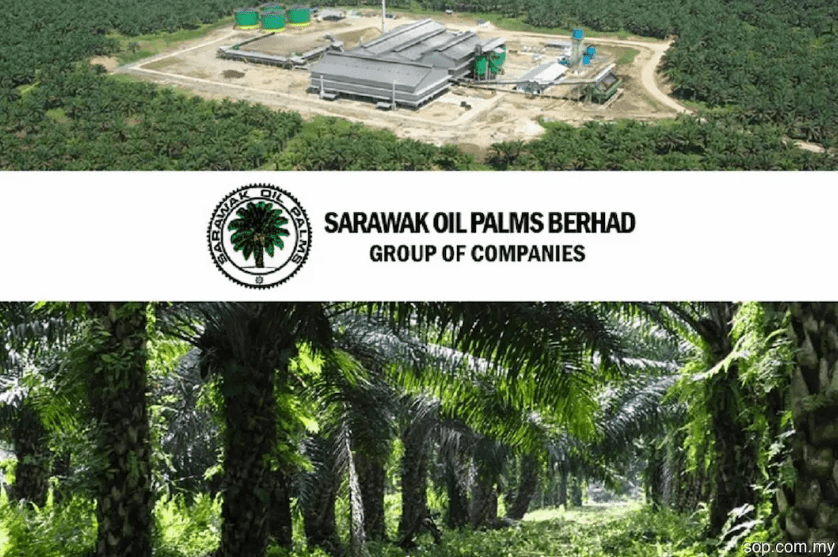
KUALA LUMPUR (May 23): Sarawak Oil Palms Bhd’s (KL:SOP) net profit surged 80% year-on-year (y-o-y) in the first quarter, thanks to higher sales and lower production costs.
Net profit for the three months ended March 31, 2024 (1QFY2024) was RM79.46 million compared to RM44.17 million over the same period a year earlier, Sarawak Oil Palms said in an exchange filing.
Revenue rose 9.8% y-o-y to RM1.33 billion from RM1.21 billion on higher volume, it said.
“The group is taking effective steps to improve its production through an aggressive recovery programme, including cost control and replanting programme,” Sarawak Oil Palms said. The industry will continue to face challenges in view of global economic conditions and softening of commodity prices, it flagged.
Average realised prices per ton for palm oil products stood at RM3,913 versus RM3,973 in 1QFY2023, while that of palm kernel products was 3.9% lower at RM2,267 versus RM2,359 in 1QFY2023.
Sarawak Oil Palms said the group’s performance will continue to be driven by the cyclical fresh fruit bunches production, global world edible oil price movement, as well as supply chain effects on fertilisers, chemicals and fuel prices which will affect production costs.
Shares in Sarawak Oil Palms ended four sen or 1.33% lower at RM2.96, valuing the planter at RM2.64 billion.
https://theedgemalaysia.com/node/712719
Sumber : The Edge Malaysia
- Details
- Hits: 729

KOTA KINABALU (June 6): Sawit Kinabalu Group (Sawit Kinabalu) will be the pioneer of the Green Technology Park (GTP) in Sabah, at the same time supporting the state government’s efforts towards achieving sustainable development goals.
In order to realise that goal, Sawit Kinabalu through its subsidiary, Sawit Palm Oil Industrial Cluster Sdn Bhd (SPOIC) signed a Memorandum of Understanding (MoU) with Nextgreen Global Berhad (NGGB) for the establishment of GTP.
Chief Minister Datuk Seri Panglima Hajiji Noor who is also the chairman of Sawit Kinabalu, witnessed the signing of the MoU at Sawit Kinabalu’s new headquarters in Block B, Menara Kinabalu on Thursday.
Sawit Kinabalu was represented by its Group Managing Director and Chief Executive Officer, Victor Ationg while NGGB was represented by its Group Managing Director, Datuk Lim Thiam Huat, as well as Datin Stella Ambrose (Sawit Kinabalu) and Datuk Mohd Yusof Din (NGGB) as witnesses for both entities.
Through the MoU, both parties will explore and implement the main activities of GTP such as establishing a collection and processing center, pulp mill, raw water treatment plant and steam boiler on 400 acres of land belonging to SPOIC in Sandakan.
GTP’s green business concept emphasises renewable energy, recovery, and waste elimination which is the basis for a green economy that can reduce environmental risks and further drive Sawit Kinabalu towards sustainable development.
Earlier, Hajiji launched Sawit Kinabalu’s new headquarters and chaired the company’s board of directors meeting.
He then witnessed the business tithe payment of Sawit Kinabalu for the year 2023 amounting to RM800,000 from Victor to the Supreme Council member of the Islamic Religious Council of Sabah (MUIS), Datuk Mohd Dandan @ Ame Alidin.
According to Victor, the Sawit Kinabalu Group is committed to continuing to fulfill its obligation to pay business tithe to help economic growth and community empowerment, in accordance with the profits recorded by the company, following the performance of CPO oil prices which are expected to increase in the future.
https://www.theborneopost.com/2024/06/06/sawit-kinabalu-group-to-pioneer-green-technology-park/
Sumber : The Borneo Post