-
Official Websites of
-
MINISTRY OF
PLANTATION AND COMMODITIES -
No. 15, Level 5-13, Persiaran Perdana, Presint 2, 62654 Wilayah Persekutuan Putrajaya


INFO ARKIB ELEKTRONIK
- Details
- Hits: 367
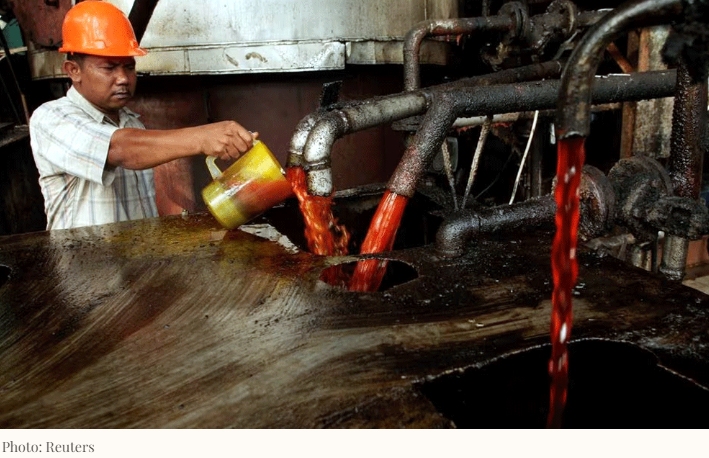
SINGAPORE: Malaysian palm oil futures rose Tuesday, reversing midday losses, as lower rapeseed projections overshadowed U.S. soybean ratings, which were as expected.
The benchmark palm oil contract for August delivery on the Bursa Malaysia Derivatives Exchange closed up 14 ringgit, or 0.36%, to 3,933 ringgit ($833.79) a metric ton.
In its first production estimates for this year’s harvest, France’s farm ministry projected the winter rapeseed crop at 4.2 million tons, down 1.2% from 2023.
Dalian’s most active soyoil contract slid 1.7%, while its palm oil contract lost 2.69%. Soyoil prices on the Chicago Board of Trade slipped 0.48%.
The USDA’s soybean crop ratings were in line with trade expectations. Soybean conditions were rated 72% “good-to-excellent” in the USDA’s first ratings of 2024 for the oilseed.
Palm oil is affected by price movements in related oils as they compete for a share in the global vegetable oils market.
While a weak ringgit is currently supporting palm oil prices, lower Malaysian exports expected in June have “capped the gains for upside” in the near term, said Mitesh Saiya, trading manager at Mumbai-based trading firm Kantilal Laxmichand & Co.
Palm gains on firm crude but logs weekly decline
Cargo surveyors Intertek Testing Services and AmSpec Agri said exports of Malaysian palm oil products for June 1-10 fell 20.4% and 21.6%, respectively, compared to May 1-10.
Cargo surveyor Societe Generale de Surveillance, however, estimated exports for June 1-10 at 347,045 tons, up 31.8% from 263,369 tons shipped during May 1-10.
The ringgit, palm’s currency of trade, strengthened 0.04% against the dollar after declining 0.66% on Monday.
Palm oil may fall this week towards the support levels of 3,850-3,870 ringgit per ton, with resistance at 3,980-4,000 ringgit, LSEG said in a report.3 technologies identified to boost palm oil production, cut reliance on foreign labour
https://www.brecorder.com/news/40307913
Sumber : Business Recorder
- Details
- Hits: 440
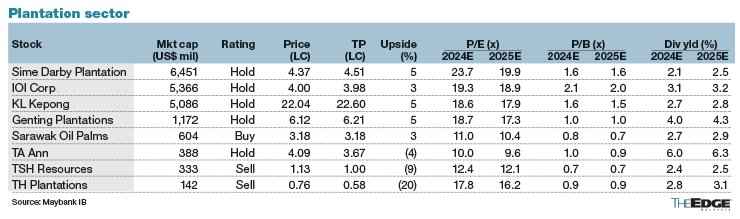

KUALA LUMPUR (March 11): Maybank Investment Bank (Maybank IB) maintained its 'neutral' rating for the plantation sector, and said the sector had played its part in ensuring food security, job security, and health security not just for the nation, but the world over during the Covid-19 pandemic.
In a sector update on Monday, the research house said despite rising cost challenges and falling output, the sector still made huge monetary contributions of more than RM23 billion over the past four years in various forms of direct and indirect taxes, and contributions.
Maybank IB said that between 2020 and 2023, the plantation sector contributed approximately RM6.1 billion in windfall profit levy, RM3.7 billion in export duties, RM1.3 billion in Malaysian Palm Oil Boar cess, RM200 million in prosperity taxes, more than RM6 billion in Sabah and Sarawak sales taxes (Maybank IB’s back-of-the-envelope estimates), and easily more than RM6 billion in corporate income taxes and individual taxes (by the smallholders) to the Malaysian government for a selected list of corporates.
“The sector is said to be among the highest tax contributors in terms of total taxes (including the windfall profit levy, export duties, Cess, and Sabah and Sarawak sales taxes, in addition to corporate taxes),” it said.
Maybank IB said palm oil holds more than 50% market share in the global vegetable oils trade.
Hence, the research house said its continuous availability is crucial to global food security as well as health security.
It said throughout the pandemic, palm oil exports never stopped, as the government allowed palm oil cultivation to proceed.
“Besides food use, the continuous availability of palm oil and palm products also meant there were the much-needed ingredients to make personal cares and cleaning products, such as hand wash, soap, laundry detergents, hand sanitisers, etc, which the world desperately needed in its fight against the highly infectious Covid-19 virus,” it said.
Maybank IB highlighted that during the pandemic, the plantation sector was among the few granted special approval by the government to operate.
It said social distancing at the workplace was inherent in the estates, given that one worker typically covers more than 10 hectares of estates, providing a naturally safe working environment.
The research house said that at the height of the pandemic, outsiders had limited access to the staffs’ housing quarters and estate operations to ensure the safety of their workers and families.
“While country borders were mostly closed initially, guest workers remained employed throughout, and were paid decent wages (plus incentives) that allowed them to repatriate the much-needed income to provide for their families back home (presumably equally affected by the pandemic),” it said.
https://theedgemalaysia.com/node/704123
Sumber : The Edge Malaysia
- Details
- Hits: 476
PETALING JAYA: The earnings of plantations companies will be on the back foot for the final quarter of 2023 (4Q23) due to weaker crude palm oil (CPO) prices during the period.
The sector could, however, see a new normal with CPO prices trading between RM3,000 and RM4,000 a tonne due to supportive fundamentals.
RHB Research expects 4Q23 earnings for the sector to decline quarter-on-quarter (q-o-q) and year-on-year (y-o-y) as production output declines post peak season and the down trending CPO prices having a higher leverage on earnings of companies.
Industry insiders expect the bearish forces could remain for much of 2024 but for CPO to hold above the RM3,000 per tonne price level, helped by sustained demand from main markets like China and India, which will help offset weaker exports to developed markets like the European Union.
“Based on the current fundamental factors such as CPO production stagnating at 18 million tonnes to 19 million tonnes in Malaysia, soybean oil prices remaining above US$900 per tonne and palm oil exports remaining stable, the CPO price range of RM3,000 to RM4,000 is considered normal,” said Datuk Dr Ahmad Parveez Ghulam Kadir, director-general of Malaysian Palm Oil Board.
He has no major concerns about Indonesia CPO production, estimated at 46 million tonnes last year, as there is no strong correlation with Malaysian CPO prices, he added.
“Even though Indonesian CPO production keeps increasing every year, their domestic consumption is also on an increasing trend due to their aggressive implementation of the biodiesel industry and higher demand for edible consumption.
“As a result, Malaysian palm oil exports remain stable in the world markets,” Ahmad Parveez told StarBiz.On the supply side, with cultivated area in Malaysia and Indonesia about to plateau, production growth will be driven by better seeds and plantation practices. One major issue is wage pressure.
“Compared with historical levels, one key factor supporting higher CPO prices is cost inflation, especially for labour,” said Akash Gupta, director at Fitch Ratings Singapore Pte Ltd.
Malaysia has a minimum wage of RM1,500 and the government is working towards a progressive wage policy to raise wages of low-income workers.
Akash’s Malaysian spot benchmark CPO price assumption is US$650 per tonne (around RM3,100) for 2024, and US$700 per tonne (around RM3,300) for 2025, as compared to US$830 per tonne (around RM3,950) in 2023.
He expects CPO prices to weaken in 2024 due to higher output as well as pressure from competing oils such as soybean oil.
“We see higher production in Malaysia, with the resolution of labour shortages which were caused by Covid-19-related restrictions. We also see favourable weather conditions for higher yields, at least in the next four to six months across Malaysia and Indonesia.
The effect of a strong El Nino, if it materialises, should start to be felt from late 3Q24 or early 4Q24 onwards. “Lower cost of fertilisers should also help raise output and weaken CPO prices,” he said.
Ahmad Perveez advised to keep an eye on crude oil prices as higher energy prices tend to make palm oil a more attractive option for biodiesel feedstock.
The weak ringgit against the US dollar also makes CPO more competitive than other competing oils.
The major immediate pressure on CPO price could be brewing in the soybean oil market with the price differential between the two edible oils having narrowed to US$200 a tonne from about US$550 a tonne in September last year.
The narrower spread between the two vegoils could lead to buyers opting for soybean oil purchases while Fitch expects this to encourage higher discretionary biodiesel blending.
With the earnings season set to get underway on Bursa Malaysia, RHB Research noted that the 4Q23 earnings of plantation companies could ease due to lower production and pricing power, especially among upstream companies.
“In Malaysia, while average fresh fruit bunch (FFB) output rose by 4.5% y-o-y in 4Q23, spot CPO prices dropped 5.8% y-o-y. In Indonesia, FFB output is estimated to have risen 3.4% y-o-y in 4Q23, but net CPO prices fell 11.1% y-o-y,” it noted in a report yesterday.
That said, the industry’s 4Q23 performance is likely to be largely in-line with its expectations, based on estimates of production levels alone.
Kuala Lumpur Kepong Bhd may underperform its forecast based on FFB output with FGV Holdings Bhd outperforming while others post numbers that are largely in line.
It added Malaysian companies with downstream operations may see slightly better q-o-q margins due to the decrease in competition from Indonesia.
Unlike Fitch, RHB Research expects a higher CPO price environment in the first-half of the year in anticipation of a seasonally weaker output and the El Nino impact.
The industry’s longer sustainability is an ongoing effort, with Ahmad Parveez noting it has been proactive in diversifying its application portfolio by exploring and investing in alternative markets where the demand for palm oil is growing.
“This includes sectors such as renewable energy, and oleochemicals products by creating eco-friendly products ranging from detergents to personal care items.
The bioplastics industry presents a novel opportunity for palm oil utilisation, offering a biodegradable alternative to conventional petroleum-based plastics. Most importantly, there is a focused effort on enhancing the value of palm oil in the food industry,” he said.
https://www.thestar.com.my/business/business-news/2024/02/08/planters-4q23-earnings-forecast-to-decline
Sumber : The Star
- Details
- Hits: 301
M.P. Evans Group, a Kent-based producer of sustainable Indonesian palm oil, has shared promising figures for the year ended 31st December 2023.
Production of crude palm oil (CPO) was up 11 per cent from 2022 at 378,500 tonnes, while palm kernel production rose 9 per cent to 80,600 tonnes.
The group enjoyed unusually high pricing for CPO in 2022 which has since flattened out to £575 per tonne, around 15 per cent lower than before.
Visit Hampshire Biz News for bright, upbeat and positive business news from the county
But this hasn’t dampened cash inflows, as the company was able to add another 10,000 planted hectares to its portfolio and pay out more than £22m in dividends over the past year.
Peter Hadsley-Chaplin, chairman of M.P. Evans, said: “The group made another stride forward in 2023, with crop and production both increasing.
“Importantly, following a period of significant investment, almost all crops are now processed in group milling facilities.
“We’re starting to see the benefits in increasing extraction rates, and this will provide further support to what will be a strong result for 2023.
“Looking to the future, the group has delivered on its stated aim of adding further hectarage close to its existing projects, which will support further growth into 2024 and beyond.”
https://thebusinessmagazine.co.uk/corporate-finance/production-and-hectarage-on-the-up-for-kent-palm-oil-business-m-p-evans/
Sumber : The Business Magazine
- Details
- Hits: 647

KUCHING: Rimbunan Sawit Bhd will undertake a series of short-to-medium term measures to beef up crop production and yield of its loss-making oil palm plantations.
Managing director Tiong Chiong Ie said the group plans to implement a recovery and rehabilitation programme to improve the conditions of these plantations.
Among the measures is the deployment of additional resources, such as machinery, equipment and human resources, to maximise fresh fruit bunch (FFB) crop recovery in the most productive blocks of the oil palm estates.
The group will upgrade, repair and carry out maintenance works on the main and field roads to facilitate accessibility to and from the plantations.
To attract more workers to its plantations, Tiong said Rimbuan Sawit would establish attractive field work piece rates plus incentives, as well as refurbish or renovate the existing workers’ quarters to upgrade their amenities and facilities or construct new workers’ accommodation.
Rimbunan Sawit group owns 16 oil palm estates in Kuching, Sibu and Miri with a total planted area of 42,478ha, representing about 60.76% of the group’s total landbank of 69,909ha.
As at Dec 31, 2022, about 49% or 20,849 ha of the oil palms were in prime mature age cluster (eight to 19 years), 17,794ha or nearly 42% were old mature (over 20 years), 1,259 ha (young mature) and 2,576 ha (immature).
The group also owns and operates three palm oil mills.
Via wholly-owned subsidiaries R.H. Plantations Sdn Bhd and Jayamax Plantation Sdn Bhd, Rimbunan Sawit has entered into sales and purchase agreements with Mahawangsa Sungai Bok Plantation Sdn Bhd (formerly known as Hua Seng Plantation Sdn Bhd) (MSBPSB) to dispose of two loss-making oil palm plantations known as the Selangor Estate and Jayamax Estate in Miri Division, northern Sarawak for a total of RM165mil in cash.
The Selangor Estate covers 4,857ha and Jayamax Estate 5,077.66ha, which also include buildings.
In a circular to shareholders on the proposed disposal of the Selangor Estate and Jayamax Estate, Tiong said besides these two estates, the group has other loss-making oil palm plantations.
However, he did not disclose the number and size.
Rimbunan Sawit shareholders will vote on the proposed disposals at an EGM on April 8.
According to Tiong, the Selangor Estate and Jayamax Estate had been loss-making for three consecutive financial years up to 2022.
This was mainly because of shortage of oil palm harvesters as a result of travel restrictions and border closures imposed by the federal government to curb the spread of Covid-19 pandemic, as well as adverse weather conditions arising from the El Nino phenomenon in 2020.
This, he pointed out, had resulted in low FFB production and yield of the estates.
As both the Selangor Estate and Jayamax Estate are located at the boundary of the group’s oil palm estates in Miri, Tiong said their disposals are expected to cause minimal disruption to the operations of the group’s other oil palm estates within the region.
“Furthermore, given that the Selangor Estate and Jayamax Estate are adjacent to each other, disposing them together would enable MSBPSB to achieve economies of scale by operating the Selangor Estate and Jayamax Estate together,” he added.
The sales of the Selangor Estate and Jayamax Estate would reduce Rimbunan Sawit group ‘s total planted landbank by 17.99% or 7,643 ha.
Rimbunan Sawit group had suffered net losses for five consecutive years to 2022 but the losses had been reduced substantially from RM148.7mil in 2018 (revenue: RM338.7mil) to RM62.8mil (RM284.7mil) in 2019, to RM56.1mil (RM385.5mil) in 2020,to RM6.98mil (RM541.5mil) in 2021 and RM5.8mil (675.9mil) in 2022.
In 2023, the group made a turnaround and returned to the black with profit of RM24.5mil on revenue of RM507.8mil.
Tiong said the proposed disposals of the Selangor Estate and Jayamax Estate represents an opportunity for the group to unlock the value at a premium to their respective market value.
The group is expected to record a pro forma gain on disposal of about RM77.94mil.
From the proceeds of the sales, he said the money would be utilised for partial repayment of the group’s interest-bearing borrowings of about RM86.11mil.
This is expected to result in an interest cost savings of about RM3.99mil per annum and lower the group’s gearing level to 0.61 times from 0.99 times.
“In addition, part of the proceeds of the proposed disposals will be channelled towards the group’s business operations, as it will be utilised to fund new planting and replanting of oil palms. In that regard, the group will be able to conserve its internally generated funds to strengthen its financial position.”Going forward, Tiong said the group will seek opportunities to replenish and expand its plantation assets.
“The group takes cognisance that the foreign worker availability in Malaysia is gradually improving and expects healthy soil moisture conditions and lower-flooding disruptions to support output of its palm oil products, which bodes well for the performance of its oil palm estates in the longer term.
“Furthermore, with expectations of firmer palm oil prices and greater demand of palm oil products from the market, coupled with the group’s continuous efforts to optimise its operations and costs to drive greater efficiency and productivity, the group is cautiously optimistic on the outlook of the oil palm plantation segment as well as the financial performance of the group,” he added.
https://www.thestar.com.my/business/business-news/2024/04/01/rimbunan-sawit-to-beef-up-crop-production-and-yield
Sumber : The Star