
-
Official Websites of
-
MINISTRY OF
PLANTATION AND COMMODITIES -
No. 15, Level 5-13, Persiaran Perdana, Presint 2, 62654 Wilayah Persekutuan Putrajaya


INFO ARKIB ELEKTRONIK
- Details
- Hits: 351
KUALA LUMPUR, April 30 (Reuters) -Malaysian palm oil futures fell on Tuesday after gaining for two consecutive sessions, as weaker crude oil prices weighed ahead of cargo surveyors' exports estimates for the month.
The benchmark palm oil contract FCPOc3 for July delivery on the Bursa Malaysia Derivatives Exchange slid 79 ringgit, or 2.02%, to 3,836 ringgit ($804.19) during early trade.
The contract lost 0.69% in overnight trade.
FUNDAMENTALS
* Cargo surveyors are expected to release Malaysian palm oil exports estimates for April later on Tuesday.
* Oil edged down in early trade after Israel-Hamas ceasefire talks in Cairo helped quell market fears of an expanded conflict in the Middle East, while worries about the outlook for U.S. interest rates weighed on the market.
* Weaker crude oil futures make palm a less attractive option for biodiesel feedstock.O/R
* Dalian's most-active soyoil contract DBYcv1 lost 0.65%, while its palm oil contract DCPcv1 slipped 1.51%. Soyoil prices on the Chicago Board of Trade BOcv1 were down 1.44%.
* Palm oil is affected by price movements in related oils as they compete for a share in the global vegetable oils market.
* The Malaysian ringgit MYR=, palm's currency of trade, weakened 0.1% against the dollar, making the commodity less expensive for buyers holding the foreign currency.
* Palm oil may revisit its April 25 low of 3,817 ringgit per metric ton, as it failed twice to break resistance at 3,942 ringgit, Reuters technical analyst Wang Tao said. TECH/C
MARKET NEWS
* Asian stocks inched higher on Tuesday as investors awaited a slew of economic data, corporate earnings and the U.S. Federal Reserve's policy meeting, while the yen was slightly weaker a day after suspected intervention rescued it from 34-year lows. MKTS/GLOB
https://www.xm.com/research/markets/allNews/reuters/palm-oil-opens-2-lower-ahead-of-malaysia-export-estimates-53825450
Sumber : XM Global (FSC)
- Details
- Hits: 293
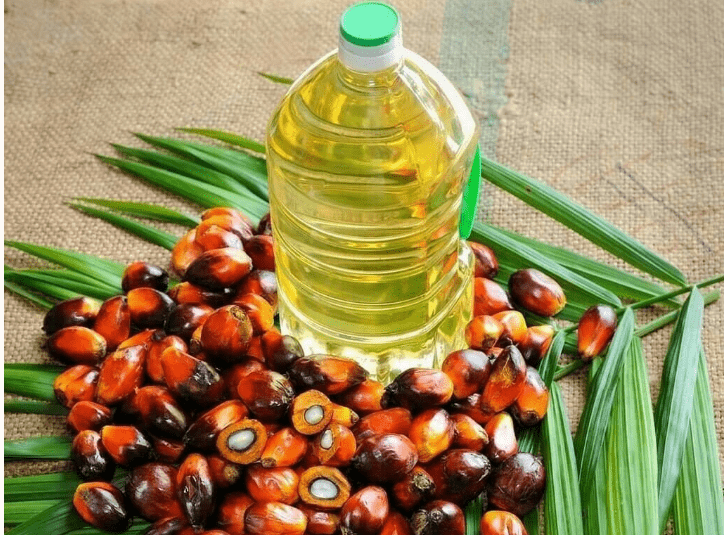
KUALA LUMPUR: Malaysian palm oil futures opened lower for the second straight session on Thursday after the Labour Day holiday, tracking weakness in Chicago soyoil.
Malaysian palm oil futures drift lower
The benchmark palm oil contract for July delivery on the Bursa Malaysia Derivatives Exchange was down 9 ringgit, or 0.24%, at 3,809 ringgit ($798.70) per metric ton at 0236 GMT.
Fundamentals
Malaysian palm oil exports fell between 9% and 11.5% in April from a month earlier, cargo surveyors Intertek Testing Services and Amspec Agri said.
Indonesia, the world’s biggest palm oil exporter, maintained its palm oil export tax and levy unchanged for May at $52 per ton and $90 per ton, respectively.
Indonesia’s February palm oil shipments tumbled by a quarter as buyers switched to cheaper rival vegetable oils.
Soyoil prices on the Chicago Board of Trade were down 0.25%. The Dalian Commodity Exchange is closed until May 5 for International Labour day holidays.
Palm oil is affected by price movements in related oils as they compete for a share in the global vegetable oils market.
Palm oil FCPOc3 may test support at 3,787 ringgit per metric ton, a break below which could open the way towards the 3,744-3,760 ringgit range.
https://www.brecorder.com/news/40301381
Sumber : Business Recorder
- Details
- Hits: 536
SASKATOON — Canada’s canola growers should not expect much price support from palm oil in 2024-25.
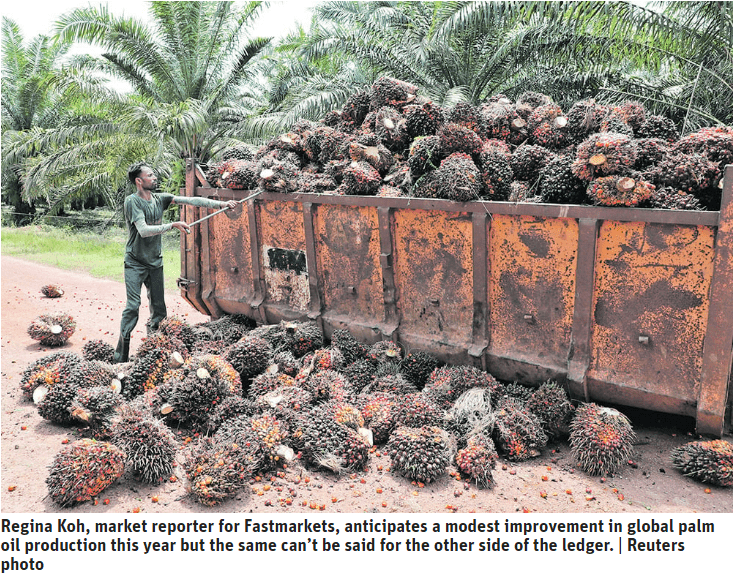
Regina Koh, market reporter for Fastmarkets, anticipates a modest improvement in global palm oil production this year, but the same can’t be said for the other side of the ledger.
“There is no strong demand catalyst to propel prices significantly higher,” she said during a recent Fastmarkets webinar.
Palm oil prices are about half the level they were at the peak of 2022, shortly after the outbreak of war in Ukraine and Indonesia announcing an export ban on the product.
That led to palm oil trading at a premium to rival products such as soybean oil and sunflower oil for a prolonged period.
Prices cooled in 2023 and then perked up again in April 2024 due to tightness of supply compared to soybean and sunflower oil.
Prices have since subsided due to the official demise of El Nino and the anticipated arrival of La Nina somewhere in the July to September timeframe.
El Nino typically hurts palm oil production while La Nina enhances it, although there can be a six-to-nine-month lag for weather effects on trees.
Koh expects Malaysian crude palm oil futures prices in 2024 to remain rangebound in the neighbourhood of 3,600 to 4,000 Malaysian ringgets (MYR).
That is well below the highs of 7,000 MYR achieved in 2022 but in line with the 2023 average of 3,796 MYR.
Malaysia’s crude palm oil production was 7.5 million tonnes for the first five months of 2024, which is better than it has been for the same period the last three years.
She expects total annual production to be in line with the 19.26 million tonnes produced in 2020. That is due primarily to better labour supply in the post-COVID era.
Indonesia’s prices have been elevated longer than usual due to low stocks heading into 2024.
The country has a “chronic problem” of aging trees and slow replanting of those trees.
However, improved fertilizer application and a mild El Nino should result in 48 million tonnes of production for the world’s biggest palm oil producer.
That would be down from last year but similar to 2022’s output.
However, the country’s new B35 (35 per cent) biodiesel blending mandate could reduce the amount of supply available for export.
An estimated 13.41 million kilolitres of biodiesel will be consumed, up from 13.15 million kilolitres in 2023.
Koh anticipates the government will boost the mandate to B40 (40 per cent) by the end of the year.
Palm had been trading at a premium to soybean and sunflower oil into the Indian market earlier this year but that has changed in recent months.
“Palm is back to trading at a discount to its rivals,” she said.
“This will help to boost its demand for June and July imports.”
India imported a record 16.5 million tonnes of vegetable oil in 2022-23 (October-November). She expects that number to fall to 15.2 to 15.6 million tonnes in 2023-24.
The country is expected to harvest a good crop of its own oilseeds, particularly rapeseed. As well, edible oil prices are higher than last year, which is discouraging imports.
India’s palm oil imports are forecast at 9.4 to 9.6 million tonnes, which would be a drop from last year due to stiff price competition from soybean oil now that Argentina is back in the market.
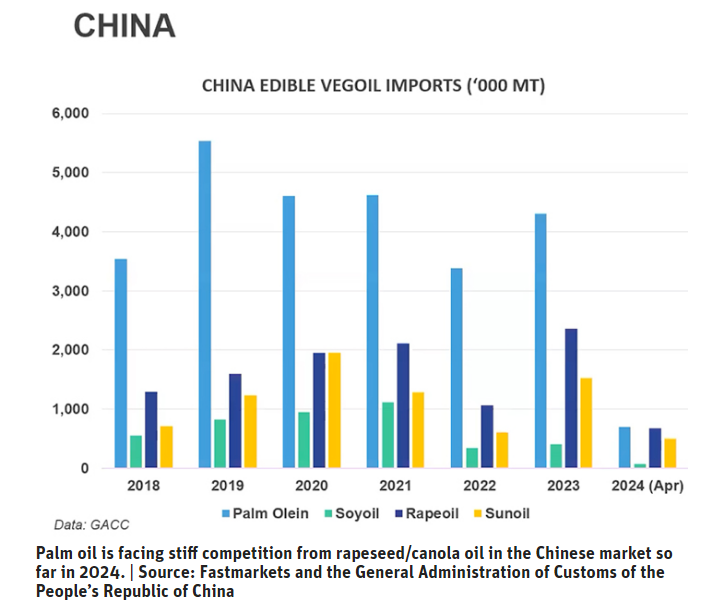
China’s vegetable oil imports peaked at 10.4 million tonnes in 2021.
“Since then, it has been a bit of a yo-yo,” she said.
Imports fell in 2022 and then rebounded in 2023. She thinks vegetable oil imports will dip to 8.43 million tonnes in 2024 from 9.93 million tonnes last year.
Restocking is happening at a slower pace than last year, partly because of the surge in palm oil prices in March-April.
Palm oil is facing stiff competition in China from competing products, particularly rapeseed/canola oil.
https://www.producer.com/news/palm-oil-prices-cool/
Sumber : The Western Producer
- Details
- Hits: 452
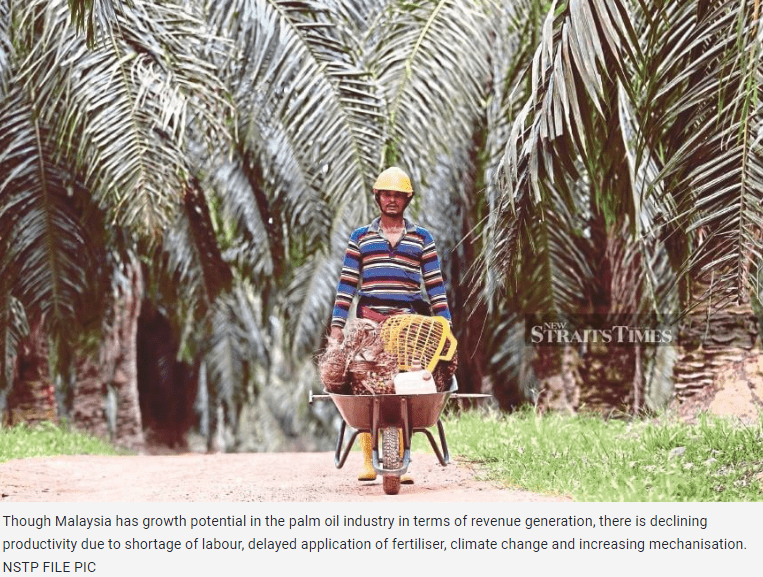
LETTERS: Though Malaysia has growth potential in the palm oil industry in terms of revenue generation, there is declining productivity due to shortage of labour, delayed application of fertiliser, climate change and increasing mechanisation.
While the government has a vision for the industry, the structure and research and development efforts are still scattered compared with Indonesia.
The New Energy Road Policy and Biomass Action Plan have articulated the government's initiatives to develop the biomass industry.
These plans underline the importance of establishing infrastructure, including transportation networks and storage facilities.
Experts recommend the implementation of a circular economy and the establishment of biomass hubs to boost the revenue stream in the palm oil industry.
A circular economy involves incorporating current practices and exploring alternative solutions to address challenges.
This approach could prompt the authorities to establish governance structures to capitalise on industry revenue, which is anticipated to be substantial.
Moreover, adopting a circular economy can enable the nation to generate high-value products for the top 12 value-added chemicals that have not yet been fully commercialised, apart from creating jobs.
The environmental safeguard measures were featured at COP28 (the 28th United Nations Climate Change Conference) in November 2023 and Davos (54th Annual Meeting of World Economic Forum) this month.
The adoption of a circular economy in the palm oil industry will not only boost the economy but also reduce greenhouse gas emissions.
Circular economy principles promote efficient resource use, reducing waste generation in the production process. This includes optimising land use for oil palm cultivation, minimising water usage and optimising fertiliser application.
Instead of disposing of by-products and waste materials, a circular economy encourages their reuse or conversion into resources.
For instance, palm oil mill effluent can be treated to extract biogas for energy production, reducing methane emissions.
Adopting integrated pest management practices reduces the reliance on chemical pesticides, mitigating environmental impact and improving ecosystem health.
Circular economy principles align with the transition to renewable energy sources.
In the palm oil industry, this involves adopting renewable energy technologies, such as solar, wind, and biomass, to power processing plants and reduce dependence on fossil fuels.
Circular economy principles emphasise the importance of consumer awareness and responsibility.
Informed consumers can drive demand for sustainably produced palm oil, influencing industry practices.
Nevertheless, we should be more than inspired as the projected revenue for 2024 for the oil palm industry is RM110 billion, indicating better times with the right action and execution of plans and policies.
https://www.nst.com.my/opinion/letters/2024/01/1003982/palm-oil-sector-must-adopt-circular-economy
Sumber : New Straits Times
- Details
- Hits: 1201
SANDAKAN: Smallholders in the palm oil industry, especially in Sabah, are advised to seize the opportunity to get the Small Palm Oil Smallholder Planting Financing Incentive Scheme for the replanting.
Deputy Minister of Plantation and Commodities, Datuk Chan Foong Hin said this matching grant involves an allocation of RM100 million which will be fully channelled by Agrobank.
He explained that the incentives announced in the 2024 Budget were prepared and introduced by the government through the Ministry of Finance and the Ministry of Plantation and Commodities.
Thus, Chan suggested small oil palm farmers to take the initiative to replant to replace old trees as a reinvestment measure.
Chan was met by the media after attending the Replanting Seminar organised by the Malaysian Palm Oil Association (MPOA) at the Sabah Hotel, recently.
Commenting further on replanting, Chan said, this issue is very critical and important to be discussed in the oil palm industry.
“In 2023, Sabah will have 1.51 million hectares of oil palm trees. However, of this amount, 33 percent, which is approximately 500,000 hectares, consists of oil palm trees aged 20 years and above.
“When a palm tree is over 20 years old, the yield we can get from the palm will decrease, so it is very important that we (industry players) always improve ourselves for the practice of replanting in a disciplined manner,” he said.
However, Chan praised oil palm industry players in Sabah for successfully replanting 61,421 hectares.
“Compared to the nationally low replanting rate of 1.8 percent between 2014 and 2023, Sabah achieved a remarkable 4 percent replanting rate with 61,421 hectares in 2023.
“The large increase of 36,218 hectares replanted in 2022 reflects Sabah’s commitment to industrial rejuvenation,” he commented.
Elaborating on the one-day seminar attended by 350 oil palm industry players, Chan hoped that the seminar would become a platform to find an agreement in replanting efforts.
“In this ever-evolving landscape, palm oil emerges as a beacon of hope—a symbol of resilience and prosperity to provide food, not fuel and fuel for the world.
“It is important that we respond to the challenge and the willingness to reinvest by accelerating replanting because the global demand for cooking oil is expected to increase when the world’s population approaches 10 billion by 2050,” he added.
https://www.dailyexpress.com.my/news/233321/palm-oil-smallholders-told-to-apply-for-replanting-/
Sumber : Daily Express