-
Official Websites of
-
MINISTRY OF
PLANTATION AND COMMODITIES -
No. 15, Level 5-13, Persiaran Perdana, Presint 2, 62654 Wilayah Persekutuan Putrajaya


INFO ARKIB ELEKTRONIK
- Details
- Hits: 534
MALAYSIAN palm oil producer Johor Plantations Group (JPG) and a shareholder expect to raise about RM735 million (S$211 million) in an initial public offering (IPO), putting the group on track to execute the country’s biggest listing in over two years.
JPG kicked off its IPO on Wednesday (Jun 12) with an offering of up to 875 million shares, representing a 35 per cent stake in the company, according to terms of the deal seen by Bloomberg News. The IPO exercise values the palm oil firm at RM2.1 billion.
The share sale is set to be the largest in Malaysia since Farm Fresh’s US$240 million offering in March 2022, data compiled by Bloomberg show. JPG’s parent – Kulim Malaysia, the plantations arm of Johor Corp, the development and investment business of the Johor state government – is also offering shares in the IPO, and will retain a 65 per cent stake in the company after the listing.
“We intend to diversify to meet our future growth aspirations by becoming a fully integrated palm oil producer through our venture into the downstream segment, which focuses on speciality oils and fats,” JPG managing director Mohd Faris Adli Shukery said in Kuala Lumpur.
Malaysia is the world’s biggest palm oil producer after Indonesia. JPG will be Johor Corp’s second unit to be publicly listed after healthcare division KPJ Healthcare, which is valued at RM8.56 billion.
The IPO comes as benchmark prices for palm oil traded in Kuala Lumpur disappoint analysts due to lukewarm demand. A strong US dollar, a tepid Chinese economy and concerns of a robust recovery in supplies from the world’s biggest growers have contributed to the weakness. Still, prices may be supported as adverse weather lowers yields.
https://www.businesstimes.com.sg/international/asean/johor-plantations-kulim-eye-biggest-malaysian-ipo-two-years
Sumber : The Business Times
- Details
- Hits: 732
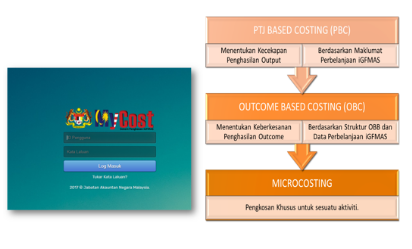
Deputy Minister of Plantation and Commodities Datuk Chan Foong Hin flanked by (from left) Malaysian Palm Oil Council CEO Belvinder Sron, Kuay Cheow Kwee from TPOZ, MPC senior undersecretary for palm oil and sago industries division Severinus Tukah, Kow Tiat Yong (KLK Oleo), Malaysian consul general in Shanghai Syed Farizal Aminy Syed Mohamad, Ku Kok Peng (KLK), Malaysian Palm Oil Board director general Datuk Dr Ahmad Parveez Ghulam Nadir and Xia Jian Jun (TPOZ).
SHANGHAI (July 11): Deputy Minister of Plantation and Commodities Datuk Chan Foong Hin on Wednesday officiated the launch of Kuala Lumpur Kepong Bhd's (KL:KLK) new high-purity fatty acids and glycerin plant in Zhangjiagang, Suzhou located in the Jiangsu province of China, bringing the facility’s annual processing capacity to 500,000 tonnes.
The oleochemical complex located on 58 acres of the third-tier city that is about 130km away from Shanghai is owned and operated by KLK’s wholly-owned Taiko Palm-Oleo (Zhangjiagang) Co Ltd (TPOZ). The expansion makes TPOZ one of the largest and most technologically advanced oleochemical production plants in China.
“TPOZ’s expansion is commendable and it’s important to highlight a Malaysian success story in China because this is a very competitive market. Not many companies could go overseas but a lot of companies that went abroad are from the plantation sector. I can safely say that Malaysia is the pioneer for this palm oil industry,” Chan said at the ribbon cutting ceremony on Wednesday.
TPOZ was incorporated in January 2004 while its first plant was commissioned in 2006.
It produces fatty acids, glycerine, soap noodles, triacetin and fatty acid esters. The products are used in various sectors such as daily chemicals, engineering plastics, rubber, textiles, paper, pharmaceuticals and coatings.
“Our journey began with the vision of becoming an integrated player in the oils and fats sector, both locally and internationally. The presence of our facility in Zhangjiagang has been pivotal in realising this vision. It has enabled us to cater to a growing market, catering to both domestic consumption and international export,” said Kow Tiat Yong, deputy CEO of KLK OLEO, KLK’s oleochemicals manufacturing division.
“Our objective has always been clear: to enhance our production capacity and seize the opportunities presented by the burgeoning market in the People’s Republic of China, a country with a vast and dynamic economy,” he added.
KLK declined to disclose the capital expenditure for the new plant, saying it needed to preserve its position in China’s highly competitive oleochemical market.
Chan was in Shanghai for a working visit to promote Malaysian palm oil and pepper.
The working visit was organised by the ministry, in collaboration with Palm Oil Research and Technical Service Institute of Malaysian Palm Oil Board.
https://theedgemalaysia.com/node/718549
Sumber : The Edge Malaysia
- Details
- Hits: 322
KUALA LUMPUR: Malaysia and the world's largest importer of palm oil, India, will work together to counter the anti-palm oil campaign by the West.
Plantation and Commodities Minister Datuk Seri Johari Abdul Ghani said India which imported 3.3 million metric tonne of palm oil worth RM13.3 billion from Malaysia in 2023, is championing Malaysia's palm oil products growth and export potential.
"India wants us to emphasise on sustainable palm oil production that can be exported to many more countries," he said.
India's push should be motivation enough for local industry players to ramp up sustainable palm oil production.
Johari is in New Delhi leading the Malaysian Agricommodity Economic Mission to India from July 17 to 18, to strengthen bilateral trade relationship and explore new cooperation opportunities.
"Industry players should start thinking about sustainable palm oil production and we hope they will continue to focus on increasing productivity," he said.
Today, Johari met with representatives from Adani Wilmar Ltd, a joint venture that has been in operation for over 25 years in India, an importer of palm oil products from Malaysia.
Tomorrow, he is scheduled to pay a courtesy call to the Indian Minister of Agriculture and Farmers' Welfare to discuss issues and proposals related to trade cooperation in the agricommodity sector of both countries.
Johari will also hold an engagement session with Indian vegetable oil industry players and will deliver a keynote address at the Indian Vegetable Oil Producers Association (IVPA) Global Roundtable 3.0 Conference at IVPA's recommendation.
The round table conference will be attended by leaders of the Indian vegetable oil industry.
India is a main export market for Malaysia's palm oil followed by China.
https://www.nst.com.my/amp/business/economy/2024/07/1077901/malaysia-and%C2%A0india%C2%A0-work-together-counter-anti-palm-oil-campaigns
Sumber : New Straits Times
- Details
- Hits: 343
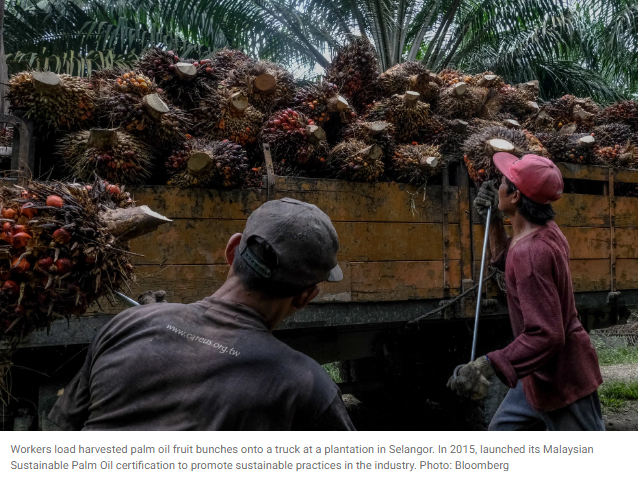
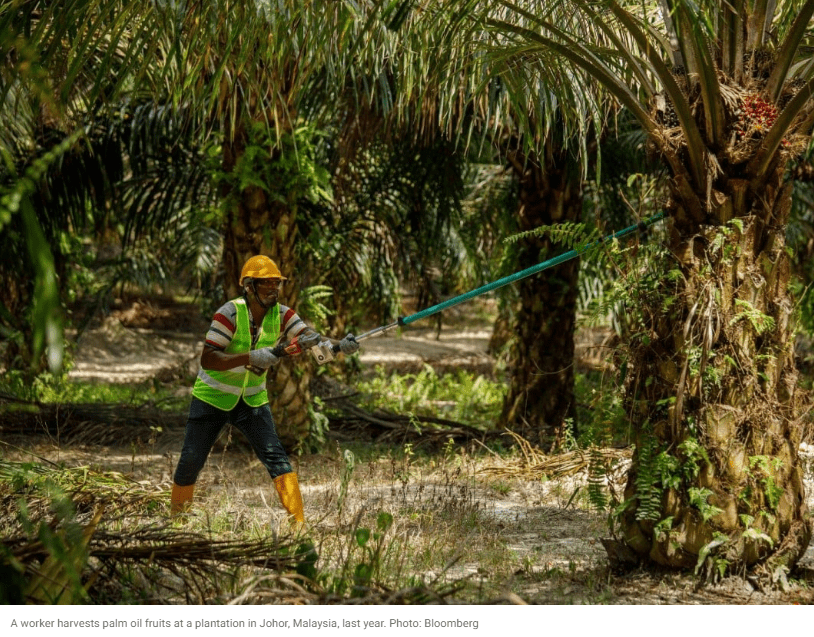
Malaysia’s palm oil industry is hoping to get a fresh kick from China’s insatiable appetite for mala hotpot as the world’s second-largest producer of the vegetable oil looks to diversify markets for a sector that faces possible sanctions under deforestation rules imposed by the European Union.
On Wednesday, during Chinese Premier Li Qiang’s first official visit to Malaysia to coincide with the 50th anniversary of diplomatic ties, the two countries renewed a five-year economic and trade pact and expanded cooperation across sectors such as green technology and cross-border crime.
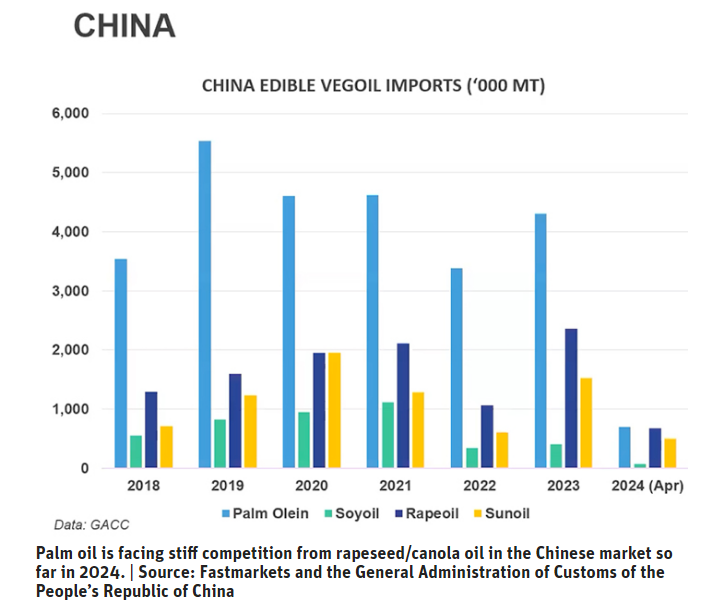
China is the second-largest importer of Malaysian palm oil, buying last year nearly 3.1 million tonnes of the controversial commodity that environmental groups have said is responsible for mass deforestation and the destruction of the habitat of critically endangered animals such as the orangutan.
But Malaysia thinks there is plenty more room to grow demand in China, which counted nearly 400,000 restaurants across the country that specialise in Sichuan hotpot in 2021, according to the official data.
The government has cooked up a plan to convince the hundreds of thousands of hotpot operators in China to consider palm oil as an alternative base for the tongue-numbing broth, which is often made from beef tallow and can be so spicy that some versions purportedly cause hallucinations.
“Palm oil is not only abundant but also versatile and stable under high heat, which is ideal for the intense cooking process of mala hotpot,” Malaysia’s Plantation and Commodities Deputy Minister Chan Foong Hin told This Week in Asia.
Chan said the government had already set up partnerships with Chinese enterprises in a bid to embed palm oil as deeply as possible in the hotpot industry supply chain, while actively promoting the benefits of using palm oil in China’s culinary traditions.
“The feedback so far has been very positive, indicating a strong potential for growth in this market segment,” he said.
Malaysia’s hotpot push began last year, when domestic restaurant operators and commercial producers of the mala hotpot soup base sought alternative fats to offset a shortage in beef tallow, which is traditionally used due to its flavour and texture.
The shift coincided with complaints filed to the World Trade Organization by Malaysia and Indonesia, the world’s largest producer of palm oil, against the EU’s deforestation regulation that the two nations said placed unfair restrictions on palm oil in favour of vegetable oils grown in Europe.
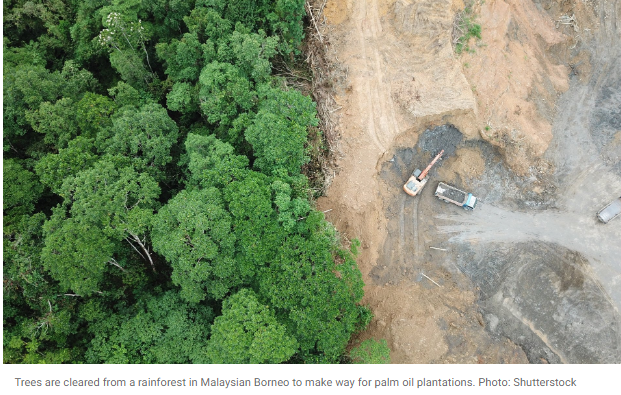
The WTO in March ruled in favour of the EU’s move to exclude palm oil as a renewable source of biofuel by 2030 under its deforestation regulation, which was formally adopted in 2021 to drop imports of crops grown on deforested land or where there is a high risk they would displace food crops.
Once in full effect, the EU’s regulation would ban the import of vegetable oils deemed to have contributed to recent deforestation. Malaysia and Indonesia have said that it places unreasonable requirements on smallholders, who can ill afford to implement technology such as GPS tracing on their produce.
Malaysia has argued that it no longer allows land clearing or deforestation to expand oil palm plantations in the country.
In 2015, it launched its Malaysian Sustainable Palm Oil (MSPO) certification to promote sustainable practices in the industry and counter the deforestation narrative that has been a common thread in diplomatic and public discussions in Europe.
The EU remains a major market for Malaysian palm oil and palm oil products.
The region imported nearly 2.8 million tonnes in 2023, but demand has seen a steady decline as EU member states face sustained public resistance to the ubiquitous oil, used in everything from making lipsticks and soaps to pastries and the popular Nutella spread.
Malaysia was actively promoting the use of MSPO-certified palm oil and palm oil products to China, deputy minister Chan said, adding that the now-mandatory certification for Malaysian-produced palm oil showed “Malaysia’s commitment to sustainable palm oil production”.
“China has shown a positive view of MSPO and is accepting imports of MSPO-certified products. More Chinese companies are expected to import MSPO-certified palm oil products in the future,” he said.
https://www.scmp.com/week-asia/politics/article/3267184/malaysia-banks-chinas-love-mala-hotpot-spice-palm-oil-exports
Sumber : South China Morning Post
- Details
- Hits: 285
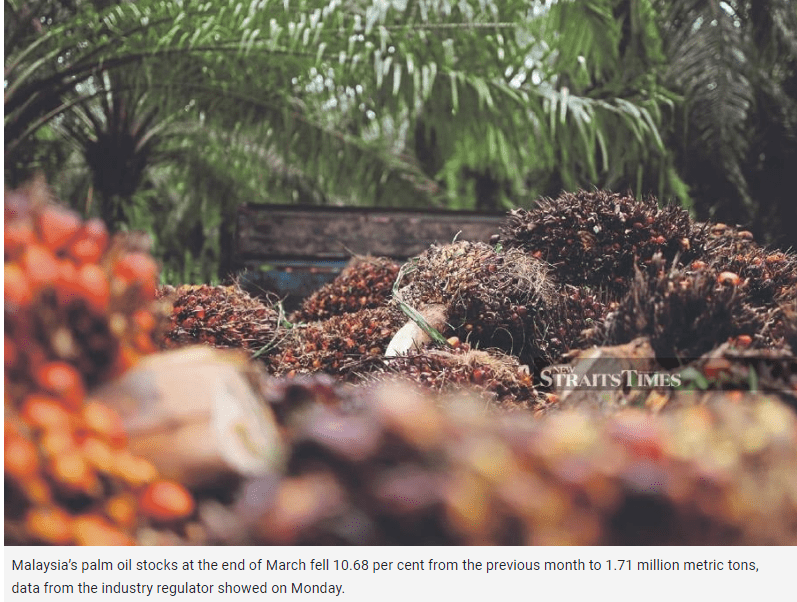
KUALA LUMPUR: Malaysia's palm oil stocks at the end of March fell 10.68 per cent from the previous month to 1.71 million metric tons, data from the industry regulator showed on Monday.
Crude palm oil production gained 10.57 per cent from February to 1.39 million tons, while palm oil exports ticked up 28.61 per cent to 1.32 million tons, said the Malaysian Palm Oil Board (MPOB).
A Reuters survey forecast March inventories at 1.79 million tons, a 6.65 per cent decline from the previous month, with output at 1.38 million tons and exports at 1.23 million tons. - Reuters
https://www.nst.com.my/business/corporate/2024/04/1038010/malaysia-end-march-palm-oil-stocks-fall-1068pc-says-mpob
Sumber : New Straits Times