-
Official Websites of
-
MINISTRY OF
PLANTATION AND COMMODITIES -
No. 15, Level 5-13, Persiaran Perdana, Presint 2, 62654 Wilayah Persekutuan Putrajaya


ARKIB BERITA
- Details
- Hits: 1046

KUALA LUMPUR, Feb 6 ― The Federal Land Development Authority (Felda) has an important role in ensuring the sustainability of Malaysia's oil palm industry so that the fate that befell the country’s rubber industry will not be repeated here, Plantation and Commodities Minister Datuk Seri Johari Abdul Ghani said.
He said Felda, being the largest owner of plantation land in the country at 800,000 hectares needs to fully utilise its strength by increasing production and focusing on the downstream sector.
"Try to imagine. If we are not focused on the downstream industry for the next 15 to 30 years, the palm oil industry will go down the same path as the rubber industry. I don't want to see that.
"We were the largest rubber producer in the world at one time. Today, we are the main producer of rubber products but we import natural rubber from Vietnam and Thailand because we do not have enough of it.
The strange thing is, we have 420,000 ha of rubber trees belonging to 290,000 smallholders,” he said in his keynote speech at the Felda 2024 Symposium here.
Malaysia produced 19.5 million tonnes of oil palm in 2013 while Indonesia produced 26 million tonnes. Malaysia’s production dropped to 18.5 million in 2023 while Indonesia’s grew its output to 46.5 million, he said.
Johari said Indonesia uses half of it for biodiesel production while Malaysia exports 15 million tonnes. He said the country's main oil palm players produced an estimated 20 tonnes of fresh fruit bunches (FFB) on a per hectare basis and suggested Felda raise its production to more than its 2023 production of 16.49 tonnes per hectare.
Therefore, he said it is important for Felda to consolidate its land assets and complete its infrastructure as best as possible.
As an example, if Felda were to produce 18 tonnes of FFB per hectare, its total yield would rise to 14.4 million FFB and the agency could become the largest producer with 2.8 million tonnes of crude palm oil (CPO), he said.
"Imagine, if the price of palm oil is RM4,000 per tonne, and the estimated cost is RM3,000, we make a RM1,000 profit. Overall, we will make a profit of RM2.8 billion.
"So, we have to learn from Felda's success first, and we put together a strategy for the next 20 to 30 years. I believe the 800,000 hectares belonging to Felda, if we are good at it, the fifth and later generation will be proud to be part of Felda,” said Johari.
He also envisioned Felda settlers to organise their land into large clusters and to fully operate their assets to produce downstream products.
"So, this oil palm industry is very important to the country. If Felda wants to be socially responsible, it is only 'sustainable' if it can make a large profit. No (company) can make a social contribution to society if it does not generate income,” he said. ― Bernama
https://www.malaymail.com/amp/news/malaysia/2024/02/06/johari-ghani-felda-must-ensure-oil-palm-industry-does-not-share-same-fate-of-rubber/116641
Sumber : Malay Mail
- Details
- Hits: 334
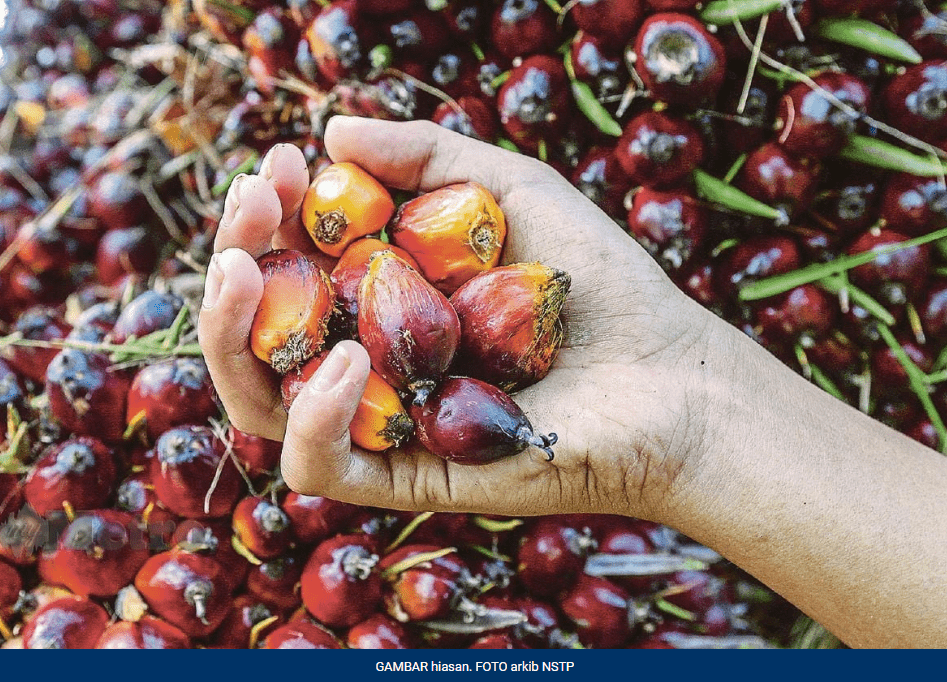
KUALA LUMPUR, Feb 7 ― The Ministry of Plantation and Commodities intends to make Egypt an essential part of its plan to expand Malaysia's palm oil exports to the African continent through the Suez Canal Economic Zone.
Its minister Datuk Seri Johari Abdul Ghani said economic cooperation in the palm oil sector between Malaysia and Egypt was discussed in his meeting with the Egyptian Ambassador to Malaysia Ragai Tawfik Nasir on Monday at his office.
"Egypt is a strategic country for our palm oil industry because palm oil makes up almost 90 per cent of Malaysia's exports to Egypt.
"Egypt has a population of more than 110 million people,” he said in a post on X today.
He also said that both countries are exploring a partnership in palm product marketing strategies involving government-linked companies along with the cooperation of private players in both countries.
In addition to Malaysia’s strong position as palm oil exporter to the country, Egypt is strategically located to be a potential gateway to other North African countries, he said. ― Bernama
https://www.malaymail.com/amp/news/malaysia/2024/02/07/johari-ghani-malaysia-to-work-with-egypt-to-expand-palm-oil-exports-to-africa/116822
Sumber : Malay Mail
- Details
- Hits: 373
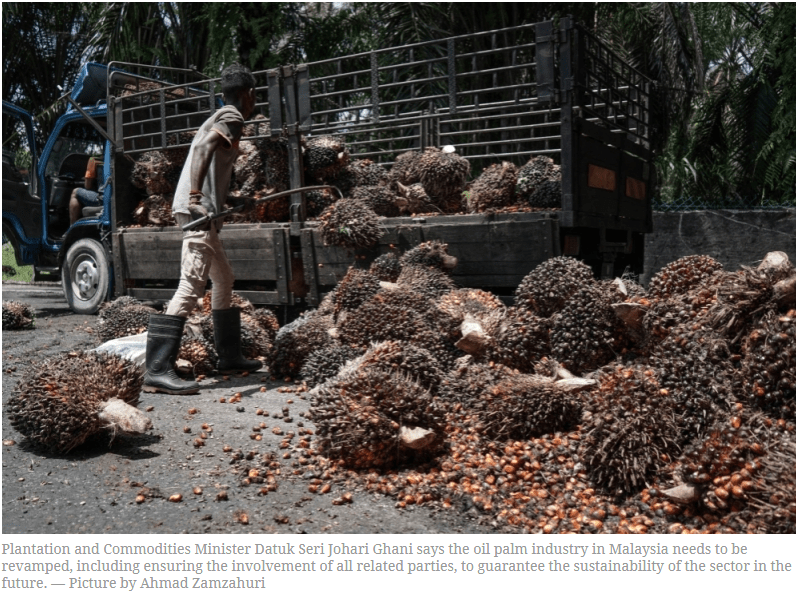
KUALA LUMPUR, Feb 29 ― The oil palm industry in Malaysia needs to be revamped, including ensuring the involvement of all related parties, to guarantee the sustainability of the sector in the future.
In stressing this matter, Plantation and Commodities Minister Datuk Seri Johari Ghani said industry players and smallholders need to work together to develop the industry without involving a lot of government allocations.
“Many issues need to be resolved, not only involving the ministry but also industry players such as the Federal Land Development Authority (Felda), Felcra Bhd and the Rubber Industry Smallholders Development Authority (Risda).
“These (institutions) have to be strong so that the smallholders can depend on them. Otherwise, it will be difficult for the smallholders and it will affect their income,” he said on Bernama TV’s Ruang Bicara programme yesterday.
Elaborating further, Johari also emphasised the importance of implementing existing policies to attract interest in the purchasing of finished products as well as raw materials in the long term.
Apart from that, the perception of employment in the industry needs to be changed especially among the younger generation. For example, young people from settler families certainly have a foundation in the industry, he noted.
“Thus, what is needed is professional training through the technical and vocational education training (TVET) that can produce professionals in this industry for the future,” he said, adding that this would help to tackle the labour shortage issues in the industry.
The minister pointed out that the shortage of about 40,000 foreign workers in the oil palm sector has significantly impacted yields, leading to an estimated loss of RM7.9 billion in export value for Malaysia.
Regarding the issue of the European Union's Deforestation-free Products Regulation (EUDR), he said the government is always aware and compliant with the rules to produce quality palm oil and preserve its sustainability.
“I want to see every estate in Malaysia become a world-class plantation, with that all parties must comply with the guidelines and regulations that have been set,” he added.
Johari said through the Agricommodity Policy 2030, the government will preserve the environment as well as increase the productivity of the workforce and protect workers' rights.
This positive development will increase the value of palm oil exports and attract investments into the country, he added. ― Bernama
https://www.malaymail.com/news/money/2024/02/29/johari-ghani-oil-palm-industry-needs-to-be-revamped-to-be-more-sustainable/120656#google_vignette
Sumber : Malay Mail
- Details
- Hits: 254
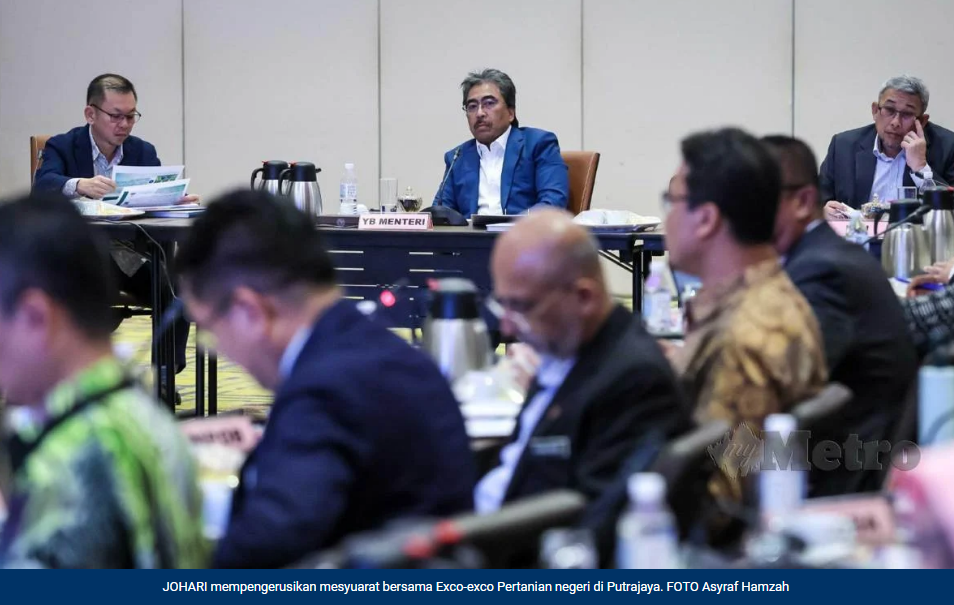
KUALA LUMPUR (May 26): Plantation and Commodities Minister Datuk Seri Johari Abdul Ghani will lead a Malaysian delegation to Egypt and Türkiye for a working visit from May 27 to June 1, 2024.
He is also scheduled to officiate the Malaysian Palm Oil Forum Egypt 2024 in Cairo on May 28.
In a statement on Sunday, the Plantation and Commodities Ministry said the annual forum, organised by the Malaysian Palm Oil Council, (MPOC) seeks to explore the growth potential for palm oil in the North African region.
In his keynote address at the forum, Johari is expected to highlight the increasing global demand for cooking oil and its derivatives, as well as Malaysia's commitment to sustainable palm oil production.
In addition, he will meet Egypt’s Minister of Trade and Industry and Minister of Supply and Internal Trade to strengthen bilateral cooperation between the two countries. He will also meet business leaders in the palm oil industry.
Subsequently, Johari will visit Türkiye, where he is scheduled to meet the country's Minister of Trade on May 31. The objective is to strengthen collaboration and identify new business opportunities between Malaysia and Türkiye in the palm oil sector .
“Türkiye is an important destination for Malaysian palm oil exports, making this meeting particularly significant for Malaysia,” the ministry said.
https://theedgemalaysia.com/node/712991
Sumber : The Edge Malaysia
- Details
- Hits: 497
KUALA LUMPUR: The Plantations and Commodities Ministry will discuss with the Malaysian Islamic Development Department (Jakim) to include Malaysia Sustainable Palm Oil (MSPO) certification alongside Halal certification as a requirement for marketing palm oil.
This, according to its minister, Datuk Seri Johari Abdul Ghani, is due to the fact that Halal is a globally recognised and authoritative certification in Malaysia.
"Through MSPO, it encompasses the environment and where they can find out how the palm oil process goes until it is bottled.
"It also covers the condition of the palm oil plantation, the management of the plantation, the use of very high standards and whatever chemicals are used are safe for the product to be produced."
Hence, Johari said, the MSPO could prove to consumers that the product was not only assuredly clean, but also of high quality and safety.
He said previously, palm oil sold in the country had to be Halal-certified, irrespective of brand, and wanted MSPO to be included in the certification requirements.
"That's why if possible, we want to impose conditions on palm oil products that are marketed in the country to have an MSPO certification before they can be distributed here.
"Ideally, palm oil products sold in all stores and supermarkets in our country must have the MSPO certification," he told reporters after launching Saji's new cooking oil label with the MSPO logo and signing of a strategic collaboration between MSPO and FGV Holdings Bhd.
The MSPO certification is Malaysia's national certification standard and was developed with input from stakeholders in the palm oil industry.
The certification, first launched in November 2013, was officially implemented on a voluntary basis in January 2015 with improvements throughout the year.
Recently, the certification was revised last year with stricter standards, including a deforestation deadline of Dec 31, 2019, which meets the deadline of the European Union (EU) Deforestation Regulation.
Other revisions included the identification of greenhouse gas (GHG) emissions and their reduction monitoring plans, the introduction of new guidance on free, prior and informed consent (FPIC) and the protection of human rights defenders and whistleblowers.
https://www.nst.com.my/amp/news/nation/2024/03/1023404/johari-wants-mspo-alongside-halal-cert-requirement-marketing-palm-oil
Sumber : New Straits Times