-
Official Websites of
-
MINISTRY OF
PLANTATION AND COMMODITIES -
No. 15, Level 5-13, Persiaran Perdana, Presint 2, 62654 Wilayah Persekutuan Putrajaya


ARKIB BERITA
- Details
- Hits: 2200
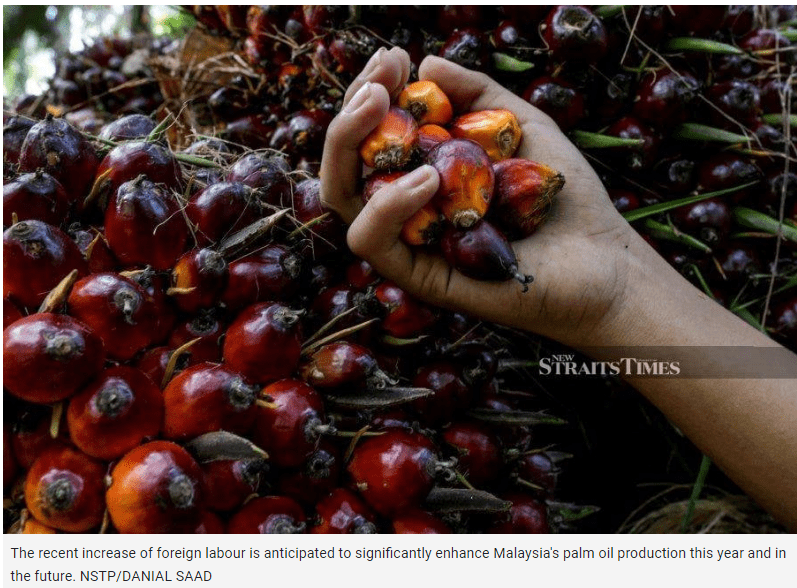
KUALA LUMPUR: The recent increase of foreign labour is anticipated to significantly enhance Malaysia's palm oil production this year and in the future.
This increase follows the implementation of the country's Labour Recalibration Programme (RTK) 2.0, which allowed employers to hire foreign workers until May 31, 2024.
Datuk Dr. Ahmad Parveez Ghulam Kadir, director-general of the Malaysian Palm Oil Board (MPOB), noted a positive correlation between labour and palm oil productivity.
Unquestionably, the recent rise in the number of foreign workers has increased production, he said.
"This can be seen in the first five months of 2024 with the rise in fresh fruit bunch (FFB) production," he told Business Times.
However, Ahmad Parveez believes that a sustainable and balanced approach is necessary, as the palm oil sector is heavily reliant on foreign labour.
He noted that while foreign workers have helped boost production, MPOB is also focused on exploring and encouraging initiatives that can reduce this dependency in the long term.
He said this includes improving mechanisation and enhancing local workforce participation.
Sunway University economics professor Dr. Yeah Kim Leng said that as one of the main sectors that rely heavily on foreign workers, the recent influx of foreign labour is expected to result in higher oil palm production.
He noted that the palm oil sector has been experiencing labour shortages since the COVID-19 pandemic in 2020–2022, causing production to decline.
"Higher demand for unskilled labour is also evident in the pick-up in farming, construction, maiding, and other manual service activities," he said.
Sharing a similar sentiment, economic analyst Dr. Zulkufli Zakaria expects an increase in palm oil production correlating with the influx of foreign workers, not only from Indonesia but also from Bangladesh.
He said the reason for dependency on labour is due to some work scopes, such as harvesting and plant maintenance, being difficult to mechanise.
Hence, he noted that the influx of foreign labour could significantly increase the national palm oil industry.
"The numbers of foreign workers have always been high since before COVID-19. The plantation and construction industries have been dominant in attracting foreign labour, although recently farming has also shown an uptrend.
"In the palm oil industry, the number of foreign workers in Malaysia increased from approximately 2.1 million in 2022 to 3 million in 2023, making up almost nine percent of Malaysia's population.
"Since 2018, there has been a significant increase in the influx of workers for the palm oil industry in Malaysia, mainly from Indonesia.
"During COVID-19, there was a critical shortage of approximately 55,000 workers by December 2022.
"Government efforts in August 2023 showed some recovery, reducing the shortfall to 41,733. Despite these efforts, turnover in this industry remains very high," he noted.
Risks of foreign labour dependency Ahmad Parveez said Malaysia's heavy reliance on foreign labour for its palm oil industry does come with certain risks.
He said, for instance, that production can be disrupted if policies restrict the entry of foreign workers, as we saw during the pandemic when international borders were closed, leading to severe labour shortages and significantly affecting FFB production.
In view of these risks, he said the government, with the support of industry players, is accelerating mechanisation programmes in order to reduce the sector's vulnerability caused by its high reliance on foreign labour.
Nevertheless, Ahmad Parveez said the government is indeed working on strategies to address this issue.
"MPOB believes that any plans that are in the pipeline will surely be implemented gradually to ensure that production remains stable while we transition.
"Our goal is to move towards a more sustainable and balanced workforce by incorporating initiatives such as mechanisation and enhancing local workforce participation," he said.
Meanwhile, Zulkufli mentioned that one of the biggest risks of foreign labour dependency is the outflow of funds from Malaysia, which could amount to billions of ringgit annually if each worker sends home only RM500 per month.
He said this could, to some extent, negatively impact the government's efforts to strengthen the ringgit.
"The second issue, following the first, is the social problems arising from the large numbers of foreign workers and polarisation issues.
"Especially notable are those not from Southeast Asia; these differences in culture and ethical practices could exacerbate social tensions," he explained.
Nevertheless, Zulkufli said the government has made efforts to reduce dependency on foreign workers by adopting new technologies such as drones, self-driving vehicles, and automating labour-intensive harvesting processes.
He noted that the government has also introduced local programmes to train local workers using new technologies and automation on plantations.
"The government has allocated RM60 million for mechanisation and automation research for the palm oil industry in 2021.
"In line with that, the Mechanisation and Automation Research Consortium of Oil Palm (Marcop) was established with the aim of reducing foreign workers and, in return, increasing productivity and efficiency," he said.
Dr. Yeah opined that the palm oil industry is highly labour-intensive, especially in planting, tending, and harvesting activities.
He said that despite decades- of research and development, the industry is still unable to mechanise and automate its fieldwork operations, especially at the harvesting stage.
"There are machines, including robots, available to perform these tasks and reduce reliance on foreign workers, but the costs remain prohibitive and outweigh the productivity gains.
"The large plantation companies have been able to increase yields and productivity through mechanisation and process improvements, but the smaller plantations and smallholders are still largely reliant on foreign workers," he added.
As such, Yeah stressed the need for more concerted investment in research and development (R&D) and ongoing innovations by large firms.
He said cost reduction is also crucial to achieving mass deployment of automation and labour-saving technology, which can reduce the country's dependence on foreign labour.
Improving foreign labour policies in the palm oil industry
In terms of optimising foreign labour policies, Ahmad Parveez believes that the government has continuously been improving policies related to foreign labour for the betterment of all industries in Malaysia.
He said the check and balance on achieving an optimal balance between local and foreign labour is regularly reviewed and adjusted through relevant policies.
"As the guardian of the Malaysian palm oil industry, MPOB believes that training programmes are crucial for improving the skills of local workers so that the gap left by foreign workers can be effectively filled.
"Besides human development programmes, MPOB is also actively promoting the adoption of automation and mechanisation in oil palm operations.
"The advancement in mechanisation and advanced agricultural technologies not only reduces the reliance on foreign workers but also decreases the dependence on manual labour as a whole and additionally improves productivity," he said.
He added that these efforts, combined with continuous policy improvements, aim to create a more sustainable and resilient palm oil industry in Malaysia.
Zulkufli, on the other hand, believes that optimising the benefits of foreign workers is a crucial effort that the government could undertake from time to time.
However, he said research must be conducted after each policy's pre- and post-implementation phases to understand the efforts made.
"These efforts include optimising benefits such as enhancing workers' rights as mentioned in international law, ensuring fair wages, safe working conditions, and access to healthcare.
"They should also integrate training focused on agricultural skills and the use of modern technologies," he noted.
Additionally, Zulkufli believes that employment contracts should be reviewed periodically to ensure they are updated based on changes in life and tasks.
He said community integration programmes could potentially be introduced to reduce social problems, and highly skilled workers could have a pathway to permanent residency.
Meanwhile, Yeah noted that salaries, wages, and consequently labour costs are expected to rise faster as the country moves forward to achieve its high-income aspirations.
He said the anticipated increase in labour costs will act as a push factor for the industry to adopt technology and increase capital intensity.
Furthermore, he stated that the government is promoting industrial upgrading through greater deployment of digitalization and Industry 4.0 technologies, including robotics, drones, and smart devices.
"These initiatives will not only reduce reliance on low or unskilled labour but also enhance overall industry efficiency and productivity.
"In the short term, flexibility in the recruitment of foreign workers is necessary to enable the industry to quickly adjust to fluctuations in production and demand," he said.
https://www.nst.com.my/business/economy/2024/07/1074927/foreign-labour-boost-%C2%A0help-palm-oil-production-year#google_vignette
Sumber : New Straits Times
- Details
- Hits: 307

THE Malaysian government is serious in resolving the issues surrounding the palm oil industry in the country, said Plantation and Commodities Minister Datuk Seri Johari Abdul Ghani.
The issues, particularly environmental and social issues, could affect the RM102 billion export potential when the country produces between 18.5 tonnes and 18.6 tonnes of crude palm oil.
This would go back to both the federal and state governments which are benefitting from the industry in terms of tax collection, almost one million people who are employed by the industry and 450,000 smallholders throughout the country.
“You know we are facing a big issue now in the world. You never see it last time but in the past 15 years people are talking about environment everywhere you go.
“If we can’t address the issue of environment we will be affected. That is why the government is to audit (under the Malaysian Sustainable Palm Oil (MSPO) certification scheme),” he said when opening Sarawak Oil Palms’ (SOP) Refinery and Fractionation Plant 2 at the Kidurong Industrial Estate Area Phase 2 here today.
Johari said Malaysia should not be penalised if the country had been found to be not in compliance with the Roundtable on Sustainable Palm Oil’s (RSPO) principles and criteria.
“I have always stressed to the European Union’s representatives whenever I have the opportunity to talk to them that if they are upset with issues in Malaysia, they should work with us closely on how to make a country like us a benchmark to the world on edible oil.
“Because for every hectare of land that we use, we can produce 3.3 million tonnes of edible oil compared to soy oil, rapeseed oil or sunflower oil that can only produce less than one tonne per hectare of edible oil,” he said.
He added that Malaysia is willing to sit down with the representatives and discuss on how to improve and become an example for the world in edible oil production.
He said palm oil production is an important industry in Malaysia which could boost the country’s economy through its upstream and downstream activities. — BERNAMA / pic AFP
https://themalaysianreserve.com/2024/04/27/govt-is-serious-in-resolving-palm-oil-industry-issues-johari/
Sumber : The Malaysian Reserve
SAWIT : Govt mulling easier loan process for oil palm smallholders in Budget 2025, says Johari Ghani
- Details
- Hits: 1237

KUALA LUMPUR (July 25): The Ministry of Plantation and Commodities will consider simplifying the loan process from banks to oil palm smallholders in the upcoming Budget 2025.
Minister Datuk Seri Johari Abdul Ghani said the government, via Budget 2024, had allocated RM100 million via a hybrid scheme in the form of a 50% grant and 50% loan to implement the Smallholder Oil Palm Replanting Financing Incentive Scheme (TSPKS 2.0).
He said his ministry recognises the difficulties oil palm smallholders face when applying for bank loans for replanting purposes, due to several conditions imposed by the banks.
“Although it is a 50% loan and 50% grant, we observed that it is quite difficult for some smallholders to secure financing, because they cannot meet many criteria.
“The ministry is looking into this, and will likely propose in the next budget how to simplify the 50% loan [portion] to facilitate smallholders with trees of over 25 years old,” he said during a question-and-answer session in the Senate on Thursday.
He was replying to a supplementary question from Senator Datuk Lim Pay Hen regarding incentives for oil palm replanting and responses to the TSPKS 2.0 initiative.
https://theedgemalaysia.com/node/720345
Sumber : The Edge Malaysia
- Details
- Hits: 1337
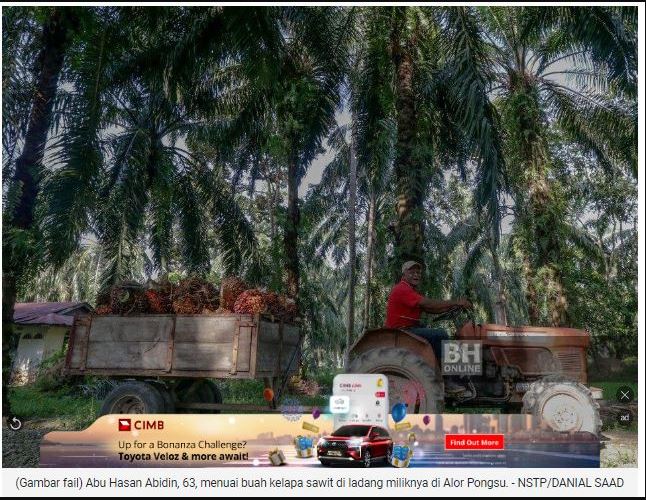
KUALA LUMPUR: Kontrak niaga hadapan minyak sawit mentah (MSM) di Bursa Malaysia Derivatives dijangka mengalami dagangan dengan kecenderungan meningkat minggu depan, didorong prospek eksport yang lebih kukuh, kata peniaga.
Pemilik dan Pengasas Bersama Palm Oil Analytics yang berpangkalan di Singapura, Sathia Varqa berkata laporan Lembaga Minyak Sawit Malaysia (MPOB) yang neutral juga dijangka menunjukkan pemulihan berterusan dalam niaga hadapan MSM.
"Laporan MPOB akan dikeluarkan pada 13 Disember. Sementara pelabur menunggu data industri, harapan permintaan lebih tinggi di Indonesia susulan kemungkinan wujudnya peraturan biodiesel baharu juga telah menaikkan harga MSM," katanya kepada Bernama.
Indonesia dilaporkan mungkin melaksanakan program untuk menggunakan B35 mulai Januari 2023 berikutan harga minyak mentah dijangkakan kekal tinggi tahun depan.
B35 ialah bahan api yang mengandungi 35 peratus campuran bahan api berasaskan minyak sawit.
Sementara itu, Peniaga Minyak Sawit, David Ng berkata MSM ditutup tinggi pada Jumaat berikutan kebimbangan mengenai pengeluaran yang lebih lemah selain stok dijangkakan lebih rendah menjelang laporan MPOB.
"Laporan itu meningkatkan sentimen lebih tinggi. Oleh itu, kami menjangkakan ia didagangkan pada kecenderungan meningkat di antara RM3,900 dengan RM4,300 satu tan minggu depan," katanya.
Bagi dagangan yang baru berakhir minggu ini, niaga hadapan MSM kebanyakannya lebih tinggi menjejaki kenaikan niaga hadapan minyak kacang soya di Lembaga Dagangan Chicago (CBOT) selain paras pengeluaran dan stok yang dijangkakan lebih rendah di negara ini.
Berasaskan mingguan, Disember 2022 susut RM76 kepada RM3,924 satu tan, Januari 2023 turun RM77 kepada 3,948 satu tan, Februari 2023 merosot RM90 kepada RM3,995 satu tan, Mac 2023 menguncup RM41 kepada RM4,032 satu tan dan April 2023 kurang RM17 kepada RM4,035 satu tan.
Jumlah dagangan mingguan meningkat kepada 352,786 lot daripada 308,528 lot minggu lepas manakala kepentingan terbuka berkurangan kepada 214,515 kontrak daripada 292,073 lot.
Harga MSM fizikal bagi November Selatan meningkat RM30 kepada RM4,030 satu tan.
– Bernama
https://www.bharian.com.my/bisnes/pasaran/2022/12/1037734/harga-minyak-sawit-dijangka-meningkat-minggu-hadapan
Sumber: Berita Harian
- Details
- Hits: 5457
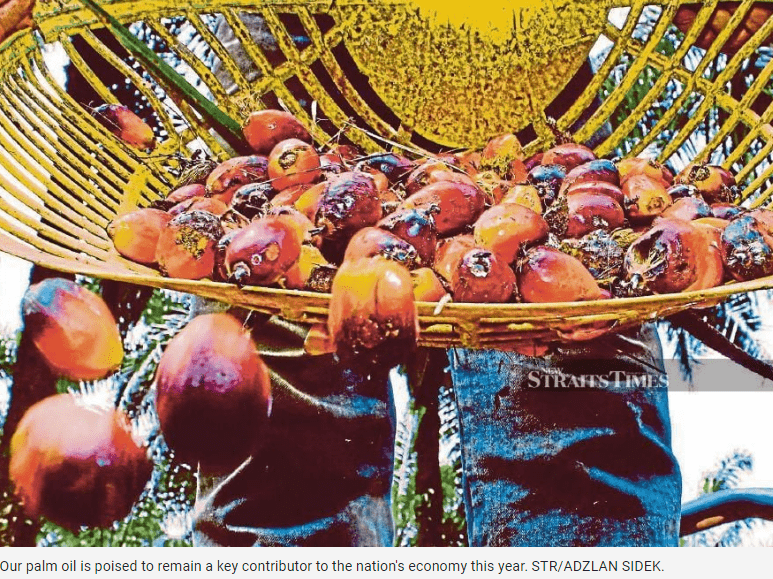
Our palm oil is poised to remain a key contributor to the nation's economy this year.
We anticipate an increase in export revenue from palm oil and palm-based products.
The rise in revenue is expected due to higher demand from our primary importers, notably
China and India, as well as improved prices of crude palm oil (CPO).
India and China together made up 28.5 per cent of Malaysia's export of palm oil for 2023 and we anticipate this trend to continue this year.
India maintained its position as Malaysia's largest palm oil export market last year for the 10th consecutive year since 2014, with 2.84 million tonnes or 18.8 per cent of Malaysia's total palm oil exports followed by China at 1.47 million tonnes (9.7 per cent).
Other significant importers were the European Union1.07 million tonnes (7.1 per cent), Kenya 0.92 million tonnes (6.1 per cent), Turkiye 0.88 million tonnes (5.8 per cent), Japan 0.55 million tonnes (3.6 per cent) and Pakistan 0.50 million tonnes (3.3 per cent).
These seven main markets contributed 8.23 million tonnes or 54.4 per cent of Malaysia's total palm oil exports in 2023.
Malaysia exported 24.49 million tonnes of palm oil and palm-based products and generated an income of RM94.95 billion for 2023. In 2024, export revenue of palm oil and palm-based products is expected at RM110 billion.
Similarly, palm oil exports may increase by 3.3 per centto 15.6 million tonnes for 2024, as opposed to 15.1 million tonnes for 2023 attributed to expected higher export demand, especially from China.
Besides, the B35 implementation (35 per cent palm oil blend in biodiesel)in Indonesia and the high crude oil price are expected to increase export demand for Malaysian palm oil.
On the other hand, we foresee the price of CPO to average higher at between RM3,900 per tonne and RM4,200 per tonne this year compared to the RM3,809.50 per tonne which will support our income from palm oil exports.
The expected higher average price of CPO may be mainly due to the tight palm oil supply as a result of unfavourable weather conditions which are expected to remain at least until April 2024. Malaysia's palm oil stocks, expected to be below two million tonnes this year will also support the price of CPO.
We foresee production of palm oil to be higher this year due to improving labour condition in the plantations which will be another contributor to the export income. We are now recording better production of CPO although the numbers are still below the actual production potential level.
In 2023, CPO production recorded an increase for the second year in a row to 18.55 million tonnes compared to 18.45 million tonnes in 2022 and 18.12 million tonnes in 2021.
The higher CPO production of 0.5 per cent in 2023 was partly contributed by the improved estate's yield performance of fresh fruit bunches (FFB) during the year, up by 1.9 per cent to 15.79 tonnes per hectare compared to 15.49 tonnes per hectare in the previous year.
In 2024, CPO production is expected to increase marginally by 1.1 per cent to 18.75 million tonnes from 2023's production due to an improvement in the labour situation and increased fertiliser application.
However, CPO production is expected to remain below potential due to the El Nino event, which is expected to affect FFB production in the second half of this year.
To expand our export market, MPOB has successfullyproduced high value palm-based products in the market, especially red palm oil, which is rich in various natural health-promoting antioxidants including vitamin E, carotene, phytosterols, squalene and coenzyme Q10.MPOB has developed and introduced value-added products utilising red palm oil, including cookies, ice cream, and various other products.
MPOB's research in the food and nutrition field has expanded the range of palm oil applications, leading to the development of new products that enhance export diversification. These include palm-based coconut milk and palm-based cheese.
Our research efforts have resulted in the successful development of tocotrienol and nano-tocotrienol from palm oil, which are known for their health benefits. These products have garnered significant demand from our export markets, reflecting their positive reception among consumers.
https://www.nst.com.my/business/insight/2024/03/1023959/higher-export-revenue-%C2%A0oil-palm-sector-year
Sumber : New Straits Times