-
Official Websites of
-
MINISTRY OF
PLANTATION AND COMMODITIES -
No. 15, Level 5-13, Persiaran Perdana, Presint 2, 62654 Wilayah Persekutuan Putrajaya


ARKIB BERITA

- Details
- Hits: 556
KLANG: The adoption of three advanced technologies have been identified as methods to enhance the country's palm oil industry and reduce the reliance on foreign labour.
Plantation and Commodities Minister Datuk Seri Johari Abdul Ghani said that these technologies – mechanisation, automation and digitalisation – could efficiently and effectively boost palm oil production.
He said government-linked company Sime Darby Plantation Bhd was currently implementing these technologies and had seen impressive results.
"The technologies being developed by Sime Darby Plantation aim to advance work mechanisation with the goal of reducing foreign labour in the future.They have invested significantly in mechanisation technology.
"For example, one worker is now required to manage every eight hectares of plantation. However, Sime Darby has increased this to 12.5 hectares, which is higher than our current ratio.
"The labour force used in our plantations, as we all know, is a significant contributor to our economy," he said after accompanying Prime Minister Datuk Seri Anwar Ibrahim on a visit to a Sime Darby Plantation site in Pulau Carey here today.
Johari said Anwar had expressed concern about the nation's palm oil industry's ability to meet demands and production.
Therefore, he said the innovative technologies developed by Sime Darby Plantation should serve as an example to achieve similar goals.
"The prime minister is very concerned about ensuring that our oil palm industry is able to continuously meet demands.
"We don't want to cut down our forests anymore. We want to stick to what we have, so we aim to enhance our abilities by using technology and reducing reliance on foreign labour."
He added that he would ensure that the Malaysian Palm Oil Board (MPOB) and other industry players adopted these technologies.
"They have already implemented some of these technologies, and others are still in the prototype stage.
"I believe that if they can successfully achieve each of these technologies and mechanisms, then I will ensure that the MPOB adopts and introduces them to everyone."
Johari also said the government would support successful start-ups in introducing new technologies.
"Anwar emphasised the importance of start-ups in introducing such technologies. When they succeed, we want to ensure they can sell their technologies to industry players," he said.
https://www.nst.com.my/news/nation/2024/05/1048930/3-technologies-identified-boost-palm-oil-production-cut-reliance-foreign
Sumber : New Straits Times
- Details
- Hits: 905
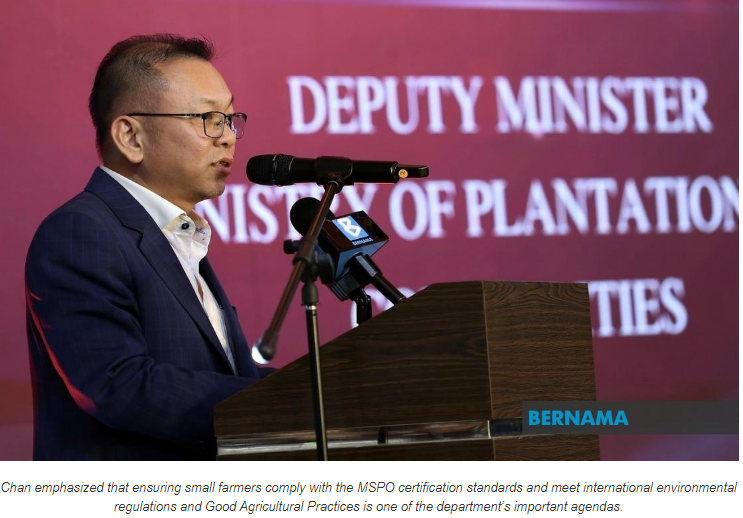
KOTA KINABALU: Deputy Plantation and Commodities Minister Datuk Chan Foong Hin said Malaysian palm oil exports to China will be increased by 3.4 million metric tonnes this year.
“We are building on last year’s agreements to strengthen agricultural and palm oil cooperation,” he said at the Malaysia-China Chamber of Commerce Sabah branch Lunar New Year Celebration 2024, here.
The celebration commemorated the 50th anniversary of Malaysia-China diplomatic relations.
“Currently, China is Malaysia’s second-largest palm oil export market. In 2023, Malaysia exported palm oil worth RM5.66 billion (1.47 million metric tonnes) to China,” he said.
China is an important market for downstream palm oil industries and palm oil products in Malaysia.
“My Ministry, through the Malaysian Palm Oil Board, has collaborated with several prominent Chinese food conglomerates such as Fujian Panpan Foods Group, Dali Foods Group and Grains Oils and Foods Co. Ltd, on various research and development initiatives for palm oil plantations,” he said.
He said this aims to increase the value-added of palm oil in downstream products, including food ingredients (such as Mala hot pot), oleochemicals and animal feed.
“I am also pleased to learn that Grand Industrial Holding’s wholly-owned subsidiary, Grand Oils and Fats (Dongguan) Co. Ltd is the first facility outside of Malaysia and in the People’s Republic of China to be certified with Malaysian Sustainable Palm Oil Supply Chain Certification Standard (MSPO SCCS) since Oct 21, 2022,” he said.
He said these achievements reflect the close trade relations between Malaysia and China and the mutually beneficial cooperation established between the two countries.
He also noted that during his tenure as Deputy Minister of Agriculture and Food Security last year, he actively promoted the protocol for fresh durian exports to China to be materialised this year.
“This initiative seeks to bring fresh Malaysian durians, such as Musang King and Black Thorn, which are known for their high quality, to Chinese consumers allowing them to experience the authentic and delectable flavours of Malaysian durians,” he said.
He also said during the 45th Asean Ministerial Meeting on Agricultural and Forestry last October, he held bilateral talks with China’s General Administration of Customs on agricultural product quarantine, resulting in six agreements and strengthening cooperation in agricultural product trade between the two countries, including durians, bird nests and aquaculture products.
“Although I have moved to a different ministry, I am hopeful that all of these efforts commemorating the 50th anniversary of Malaysia-China diplomatic relations would be achieved one by one, boosting and cementing bilateral agricultural commerce and producing further economic gain,” he said.
He also hoped to see the friendship between Malaysia and China remain strong, to achieve a brighter future by making Malaysia-China exchanges and interactions more dynamic and wonderful.
https://www.dailyexpress.com.my/news/229329/3-4-million-more-tonnes-palm-oil-for-china-minister/
Sumber : Daily Express
- Details
- Hits: 942
KUALA LUMPUR: Sik Cheong Bhd, a cooking oil distributor en route to ACE Market listing, plans to expand its product range to include high oleic soybean oil.
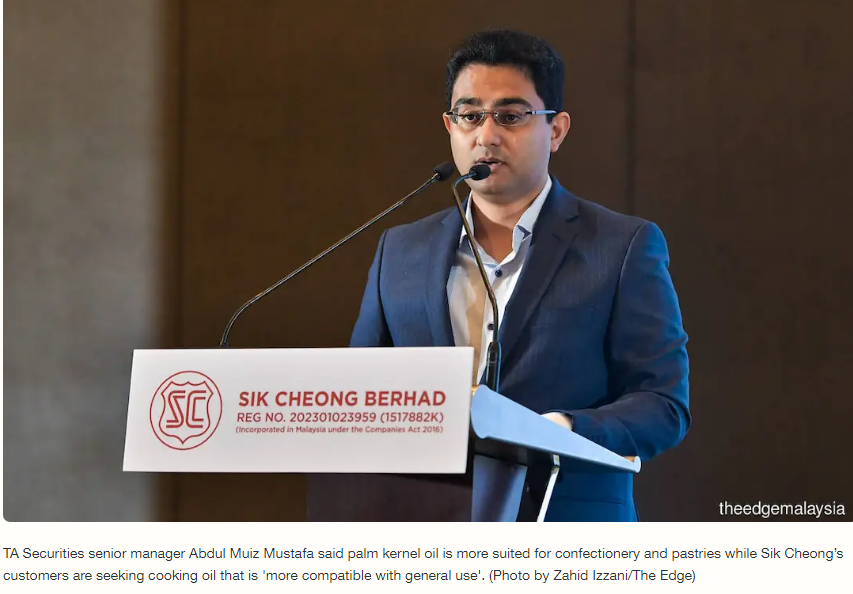
The company, which mainly repackages refined, bleached and deodorised (RBD) palm olein, has been getting enquiries from existing customers interested in the product, said Abdul Muiz Mustafa, senior manager at TA Securities advising and managing Sik Cheong’s initial public offering (IPO).
Palm kernel oil is more suited for confectionery and pastries, while Sik Cheong’s customers are seeking cooking oil that is “more compatible with general use”, he said at a press conference in conjunction with the launch of its IPO prospectus.
“This will allow them to cross-sell the product to retailers and wholesalers, and meet the demand from food manufacturers for a healthier cooking option," he said. Further, soybean oil does not require a different set of handling procedures than palm oil, Abdul Muiz added.
Sik Cheong’s IPO — priced at 27 sen apiece — involves the public issuance of 66 million new shares, which would raise RM17.82 million for the company, and an offer for sale of 20 million existing shares.
The company has set aside 40% of the proceeds to build a new packaging facility to accommodate future expansion of repackaged RBD palm olein oil business and the new venture into high oleic soybean oil, which will require additional space.
Upon completion, the company’s total operational space will increase by 88.1% to about 38,525 sq ft. The company will also buy new machinery and equipment for the repackaging of high oleic soybean oil and RBD palm olein oil products.
Currently, utilisation rate ranges from 20% to 70% depending on the packaging sizes of the products, said Abdul Muiz. “However, the primary constraint is the floor space, which is operating at nearly 95% capacity,” he said.
Sik Cheong’s production lines can handle up to 49,303 metric tonnes per year of RBD palm olein and the company is planning an annual capacity of 9,470 metric tonnes for high oleic soybean oil.
https://theedgemalaysia.com/node/719654
Sumber : The Edge Malaysia