-
Official Websites of
-
MINISTRY OF
PLANTATION AND COMMODITIES -
No. 15, Level 5-13, Persiaran Perdana, Presint 2, 62654 Wilayah Persekutuan Putrajaya


BERITA SAWIT 2024
- Details
- Hits: 726
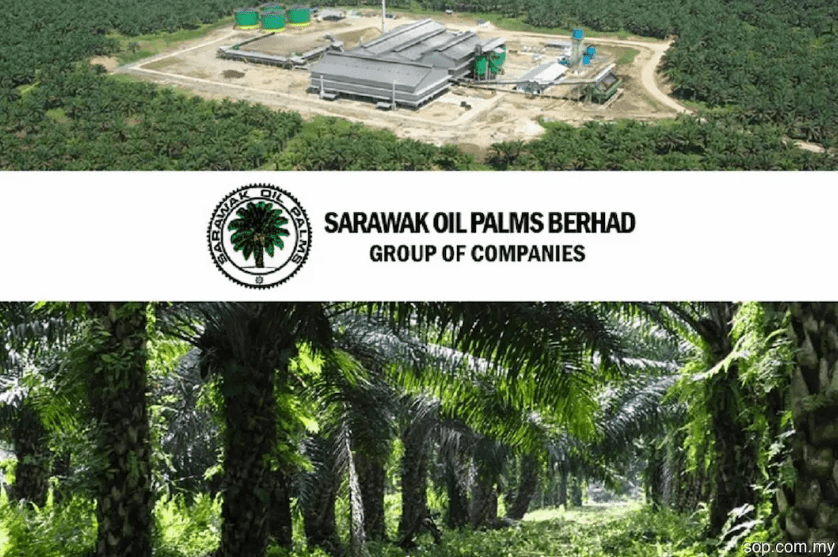
KUALA LUMPUR (May 23): Sarawak Oil Palms Bhd’s (KL:SOP) net profit surged 80% year-on-year (y-o-y) in the first quarter, thanks to higher sales and lower production costs.
Net profit for the three months ended March 31, 2024 (1QFY2024) was RM79.46 million compared to RM44.17 million over the same period a year earlier, Sarawak Oil Palms said in an exchange filing.
Revenue rose 9.8% y-o-y to RM1.33 billion from RM1.21 billion on higher volume, it said.
“The group is taking effective steps to improve its production through an aggressive recovery programme, including cost control and replanting programme,” Sarawak Oil Palms said. The industry will continue to face challenges in view of global economic conditions and softening of commodity prices, it flagged.
Average realised prices per ton for palm oil products stood at RM3,913 versus RM3,973 in 1QFY2023, while that of palm kernel products was 3.9% lower at RM2,267 versus RM2,359 in 1QFY2023.
Sarawak Oil Palms said the group’s performance will continue to be driven by the cyclical fresh fruit bunches production, global world edible oil price movement, as well as supply chain effects on fertilisers, chemicals and fuel prices which will affect production costs.
Shares in Sarawak Oil Palms ended four sen or 1.33% lower at RM2.96, valuing the planter at RM2.64 billion.
https://theedgemalaysia.com/node/712719
Sumber : The Edge Malaysia
- Details
- Hits: 728

KOTA KINABALU (June 6): Sawit Kinabalu Group (Sawit Kinabalu) will be the pioneer of the Green Technology Park (GTP) in Sabah, at the same time supporting the state government’s efforts towards achieving sustainable development goals.
In order to realise that goal, Sawit Kinabalu through its subsidiary, Sawit Palm Oil Industrial Cluster Sdn Bhd (SPOIC) signed a Memorandum of Understanding (MoU) with Nextgreen Global Berhad (NGGB) for the establishment of GTP.
Chief Minister Datuk Seri Panglima Hajiji Noor who is also the chairman of Sawit Kinabalu, witnessed the signing of the MoU at Sawit Kinabalu’s new headquarters in Block B, Menara Kinabalu on Thursday.
Sawit Kinabalu was represented by its Group Managing Director and Chief Executive Officer, Victor Ationg while NGGB was represented by its Group Managing Director, Datuk Lim Thiam Huat, as well as Datin Stella Ambrose (Sawit Kinabalu) and Datuk Mohd Yusof Din (NGGB) as witnesses for both entities.
Through the MoU, both parties will explore and implement the main activities of GTP such as establishing a collection and processing center, pulp mill, raw water treatment plant and steam boiler on 400 acres of land belonging to SPOIC in Sandakan.
GTP’s green business concept emphasises renewable energy, recovery, and waste elimination which is the basis for a green economy that can reduce environmental risks and further drive Sawit Kinabalu towards sustainable development.
Earlier, Hajiji launched Sawit Kinabalu’s new headquarters and chaired the company’s board of directors meeting.
He then witnessed the business tithe payment of Sawit Kinabalu for the year 2023 amounting to RM800,000 from Victor to the Supreme Council member of the Islamic Religious Council of Sabah (MUIS), Datuk Mohd Dandan @ Ame Alidin.
According to Victor, the Sawit Kinabalu Group is committed to continuing to fulfill its obligation to pay business tithe to help economic growth and community empowerment, in accordance with the profits recorded by the company, following the performance of CPO oil prices which are expected to increase in the future.
https://www.theborneopost.com/2024/06/06/sawit-kinabalu-group-to-pioneer-green-technology-park/
Sumber : The Borneo Post
- Details
- Hits: 669
KOTA KINABALU: Sabah-owned Sawit Kinabalu, through its subsidiary Kunak Lipids Sdn Bhd, is poised to revolutionise tocotrienols production as Malaysia’s first company to extract it from palm oil waste on a large scale.
This large-scale production is expected to commence in the first quarter of 2025 and is aligned with the government’s vision to foster economic and environmental sustainability in Sabah.
Kunak Lipids employs proprietary technology and high-precision equipment to capture tocotrienols from refined byproducts, reducing environmental waste and creating wealth, thereby contributing to the state’s economic and environmental goals.
Tocotrienols, a form of vitamin E, is used for a variety of health and therapeutic purposes due to its potent antioxidant properties.
Recognising the high demand for tocotrienols in China, Kunak Lipids, with support from the Malaysian Palm Oil Board (MPOB) and Palm Oil Research and Technical Services Institute Malaysia, identified significant market potential during initial marketing explorations.
Cosmetics manufacturers, in particular, are keen to obtain tocotrienols for their products.
Recently, Sawit Kinabalu, through Kinak Lipids, signed a memorandum of understanding with a Shanghai-based trading company, Boce Trade Service Company Ltd, to produce palm oil refinery byproducts and meet the Chinese market demand.
At the signing, Kunak Lipids was represented by its group managing director and chief executive officer Victor Ationg and Boce Trade Service Company Ltd by its general manager Qiu Rong Yu.
The ceremony was witnessed by Deputy Plantations and Commodities Minister Datuk Chan Foong Hin at Shangri-la Pudong Shanghai on June 13.
https://www.thestar.com.my/news/nation/2024/06/16/sawit-kinabalu-pioneers-large-scale-tocotrienols-production
Sumber : The Star
- Details
- Hits: 440
BINTULU (July 15): Sawit Permai Enterprise Sdn Bhd is making waves with their innovative ‘Madani MPOB F5 Improved’ fertiliser at the ongoing Sarawak Agrofest (SAF) 2024, taking place at the Old Bintulu Airport site until July 22.
Managing director Yeong Kui Po said the Madani MPOB F5 Improved fertiliser, part of the Malaysian Palm Oil Board (MPOB) F5 series, represents a significant leap forward for the country’s palm oil industry.
He added that the MPOB F5 series fertilisers are produced under licence by Briar Resources Sdn Bhd.
“Madani MPOB F5 Improved fertiliser represents a revolutionary product with state-of-the-art technology formulated by MPOB utilising Briar’s Advanced and Sustainable Series for Excellence (BASE) technology,” he told The Borneo Post.
Yeong added that the primary objective of Madani MPOB F5 Improved fertiliser is to reduce agricultural input costs, ensure consistent yields, strengthen knowledge sharing of the latest fertiliser technology, and enhance the performance of the Malaysian palm oil industry.
“Our close collaboration with MPOB aims to increase yields for small-scale palm oil farmers while reducing the presence of low-quality fertilisers in the market.
“With competitive pricing for Madani fertilisers, small farmers can enjoy significant economic benefits.
Consistent fertiliser application will not only generate higher incomes but also strengthen the financial stability of Sarawak,” he said.
Central to Sawit Permai’s offerings is BASE technology which significantly enhances crop yields through advanced nutrient delivery systems and optimised formulations, so as to improve nutrient absorption leading to healthier and more robust growth.
“BASE technology not only boosts productivity but also ensures sustainable practices by minimising chemical runoff and preserving soil health.
“By outperforming conventional fertilisers, BASE sets a new standard for agricultural excellence, achieving superior yields while promoting environmental stewardship,” said Yeong.
At Sarawak Agrofest 2024, visitors can explore Sawit Permai’s booth and witness firsthand the impact of BASE technology.
https://www.theborneopost.com/2024/07/15/sawit-permai-unveils-innovative-fertiliser-at-saf-2024/
Sumber : The Borneo Post
- Details
- Hits: 2183
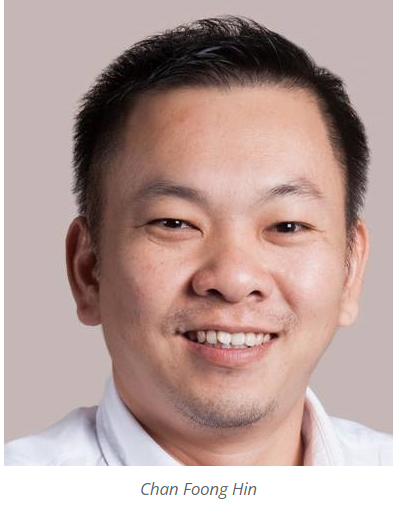
KOTA KINABALU (July 21): Deputy Minister of Plantation and Commodities, Datuk Chan Foong Hin has called on the oil palm industry players in Sabah, especially smallholders, to increase the replanting rate for aging oil palm areas to maintain the state’s palm oil productivity.
He stated that the average palm oil yield in Sabah until April 2024 had decreased by 4% compared to the same period in 2023.
“The performance of fresh fruit bunches (FFB) yield in Sabah from January to April 2024 was recorded at 4.79 tonnes per hectare, a decline of 4.0% compared to 4.99 tonnes per hectare for the same period in 2023.
“Meanwhile, for the period from January to April 2024, the FFB yield in Peninsular Malaysia was 5.18 tonnes per hectare, an increase of 19.4% compared to the same period in 2023, which was 4.34 tonnes per hectare. In Sarawak, the FFB yield increased by 8.7% from 3.80 tonnes per hectare to 4.13 tonnes per hectare,” he said in a statement on Sunday.
According to Chan, the main factor for the decline in FFB yield in Sabah was the reduction in the area of fully mature oil palm trees, which are between nine to 18 years old, with an estimated FFB productivity of around 20 to 24 tonnes per hectare per year.
“Based on statistics from the Malaysian Palm Oil Board (MPOB) in December 2023, the percentage of fully mature oil palm trees in Sabah was estimated at 33.5% compared to 33.7% in the previous year.
“Oil palm trees that have not reached full maturity or are in old age usually produce lower FFB yields, directly affecting the FFB yield for that period. By comparison, the percentage of fully mature oil palm trees in Peninsular Malaysia is 39.4%, and in Sarawak, it is 56.1%,” he added.
Therefore, Chan urged smallholders in Sabah to expedite the replanting process for aging oil palm areas.
“For eligible smallholders, it is recommended to apply for the funds provided by the government for the implementation of the Palm Oil Smallholders Replanting Financing Incentive Scheme (TSPKS) 2.0, worth RM100 million for replanting works.
“As of July 12, 2024, a total of 413 smallholders with a planted area of 1,725 hectares involving financing worth RM26.93 million had been approved by the Malaysian Palm Oil Board (MPOB),” he said.
Chan also noted that the low FFB yield in Sabah for the period from January to April 2024 was also influenced by the El Niño phenomenon and mealy bug attacks.
“Based on current data, mealy bug attacks can affect palm oil production by up to 5%. MPOB, along with the industry and the Sabah Department of Agriculture, has taken appropriate measures to address this issue.
“The MPOB’s TUNAS team is also identifying and compiling a list of smallholder oil palm plantations affected by insect attacks to provide advisory services on control measures to prevent the spread to other areas,” he said.
https://www.theborneopost.com/2024/07/21/smallholders-in-sabah-urged-to-increase-oil-palm-replanting-rate/
Sumber : The Borneo Post