-
Official Websites of
-
MINISTRY OF
PLANTATION AND COMMODITIES -
No. 15, Level 5-13, Persiaran Perdana, Presint 2, 62654 Wilayah Persekutuan Putrajaya


BERITA SAWIT 2024
- Details
- Hits: 327
KUALA LUMPUR (June 26): The crude palm oil (CPO) futures contract on Bursa Malaysia Derivatives snapped three consecutive days of losses to end higher on Wednesday on prospects of weaker production in the coming weeks, said palm oil trader David Ng.
“We see support at RM3,830 a tonne and resistance at RM3,980 a tonne,” he told Bernama.
Meanwhile, Fastmarkets senior analyst Sathia Varqa said the CPO futures traded higher in the second half session with the benchmark September contract rising RM35 to a high of RM3,894 a tonne, in anticipation of lower production data.
“The Southern Palm Oil Millers Association (SPPOMA) reported that the June 1-25 production was down by 5.62% from the corresponding period in May,” he said.
Sathia noted that the stronger CPO performance was also supported by a recovery in related edible oils on the Dalian Commodity Exchange (DCE).
According to reports, soybean oil futures closed higher on Wednesday in daytime trading at the DCE.
“The most active soybean contract for September 2026 delivery gained four yuan to close at 4,643 yuan per tonne, with total trading volume on the exchange amounting to 89,716 lots, and turnover of about 4.14 billion yuan,” it said.
At the close, the spot month July 2024 contract added RM29 to RM3,926 a tonne, August 2024 increased by RM20 to RM3,894 a tonne, and September 2024 was RM20 higher at RM3,879 a tonne.
October 2024 rose by RM19 to RM3,871 a tonne, November 2024 climbed RM20 to RM3,876 per tonne, and December 2024 gained RM19 to RM3,893 a tonne.
Total volume declined to 58,236 lots from Tuesday’s 65,240 lots, while open interest fell to 206,042 contracts from 211,517 contracts previously.
The physical CPO price for July South was RM30 higher at RM3,980 per tonne.
https://theedgemalaysia.com/node/716946
Sumber : The Edge Malaysia
- Details
- Hits: 401
KUALA LUMPUR: The slowdown in palm oil production may lead to a decline in inventory levels and positively impact global crude palm oil (CPO) price in the second half of the year, said analysts.
According to the Malaysian Palm Oil Council (MPOC), CPO price will likely stabilise at RM3,900 per tonne this month.
It said this was due to the expected drop in supply from Indonesia and Malaysia — the world's top two producers — in the second half of the year, coupled with an increase in exports.
However, it stressed that the anticipated price increase might hover around RM4,150 due to the United States' Agriculture Department (USDA) forecast of a surplus in oilseed production this year and in 2025.
"From January to May, Malaysia's CPO production increased by nine per cent year-on-year, or 626,000 tonnes, while exports rose seven per cent, or 393,000 tonnes," said MPOC.
By comparison, according to Indonesian Palm Oil Association (GAPKI) data. the country's CPO production fell by five per cent, or 647,000 tonnes, in the first quarter of the year.
Tradeview Capital Sdn Bhd fund manager Neoh Jia Man said the anticipated rise in exports indicated strong demand for palm oil, which was bullish for CPO price.
"We believe that stakeholders who consume a material amount of palm oil would seek to maintain an adequate inventory level and take advantage of the recent pullback in price to increase their stockpile.
"In addition, they could seek to diversify the supply sources or explore alternative vegetable oils," he added.
Neoh said the decline in Indonesia's CPO output was likely due to the El Nino phenomenon.
"It will have a material impact on global palm oil supply and coupled with the anticipated drop in output from Malaysia, we see upward pressure on global pricing."
Meanwhile, MPOC observed that in the European market, the prices of rapeseed oil, sunflower oil, and soyabean oil increased by six, eight and seven per cent, respectively, in May, while CPO price fell by four per cent.
"As a result, the price premium of soft oils over palm oil increased from US$40 to US$115, which is expected to support the ongoing recovery of Malaysian palm oil exports," it noted.
Commenting on this, Neoh said the increased production and stockpile of oilseeds resulted in a greater availability of alternative vegetable oils.
"This will serve to cap the potential upside of CPO price as buyers could be encouraged to switch to cheaper alternatives.
"The broader availability of those alternative oilseeds will also temper the urgency by buyers to stockpile palm oil," he added.
https://www.nst.com.my/business/economy/2024/06/1063826/cpo-price-boost
Sumber : New Straits Times
- Details
- Hits: 475
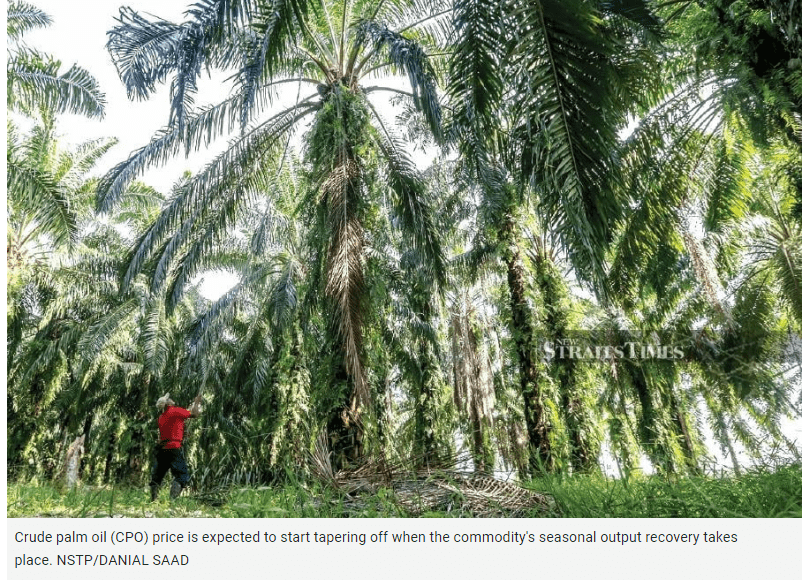
KUALA LUMPUR: Crude palm oil (CPO) price is expected to start tapering off when the commodity's seasonal output recovery takes place.
Hong Leong Investment Bank Bhd (HLIB) noted that the CPO price had averaged at RM4,062 per tonne year-to-date.
Nevertheless, HLIB has maintained its CPO price assumptions for 2024 and 2025 at RM4,000 per tonne and RM3,800 per tonne.
"Palm oil stockpiles are expected to resume an uptrend from April this year, as production will likely remain on an uptrend due to seasonality.
"Meanwhile, exports are expected to weaken due to the absence of festive-driven demand and palm oil's weak price competitiveness against other competing oils," it said in a note.
At the time of writing, HLIB said the discount of palm oil to soy oil had narrowed to US$89 per tonne, down from the six-month average of US$245 per tonne.
As such, the investment bank maintained a "Neutral" stance on the sector, given the absence of notable demand catalyst.
HLIB's top picks are IOI Corp Bhd with a "Buy" call and target price of RM4.66, while Hap Seng Plantations Holdings Bhd with a "Buy" call and target price of RM2.06.
Palm oil stock level fell for the fifth consecutive month, by 10.7 per cent month-on-month (MoM) to 1.72 million tonnes in March 2024, the lowest since May 2023.
This is as seasonally strong exports demand more than offset higher output.
The stockpile came in lower than 1.76 million tonnes estimated in a Bloomberg survey, due mainly to stronger-than-expected exports.
Meanwhile, palm oil production resumed its uptrend (for the first time since Oct 2023), rising by 10.6 per cent MoM to 1.39 million tonnes in March 2024.
Cumulatively, first quarter of 2024 (1Q24) production increased by 3.4 per cent year-on-year (YoY) to 1.05 million tonnes, with fresh fruit bunch (FFB) yield and oil extraction rate (OER) rising to 3.5 tonnes per hectare and 19.66 per cent respectively.
This is up from 3.35 tonnes per hectare and 19.52 per cent compared to the same period last year.
This improvement is attributed mainly to the enhanced availability of labour, according to HLIB's assessment.
Meanwhile, HLIB noted that exports recovered for the first time since October 2023, rising by 28.6 per cent MoM to 1.32 million tonnes in March 2024, boosted by stronger demand ahead of Ramadan and Eid ad-Fitr festivals.
During March 2024, the sharp increase in exports was driven mainly by higher exports to India, Africa and Asia Oceania, according to Intertek Services.
Cumulatively, 1Q24 exports declined marginally by 1.6 per cent YoY to 3.69 million tonnes, due mainly to lower exports to China.
Intertek Services also indicated that Malaysia's palm oil shipment increased by 12.7 per cent MoM to 431,200 tonnes during the first 10 days of Apr 2024, led mainly by higher exports to Asia Oceania, European Union, and India.
Echoing similar views, CIMB Securities anticipates palm oil supplies will remain tight in April due to fewer working days and a reduced workforce during the Hari Raya holidays.
This, combined with higher usage of palm oil for biodiesel purposes in Indonesia is likely to keep palm oil export supplies tight until April 2024.
"We project palm oil stocks to fall by 13 per cent MoM in April 24.
"We are of the view that palm oil stocks could bottom out in April before rising in May due to the seasonal rise in palm oil supply and stiff competition from other edible oil substitutes (currently traded at a discount to palm oil).
"However, competition with sunflower oil from the Black Sea region could ease slightly in the near term due to higher shipment costs to transport them to Asia owing to the threat of Houthi attacks," it added.
CIMB also said in the second half of 2024 (2H24), palm oil supply could fall short of expectations due to the lower rainfall observed in some parts of the palm oil region since late Jan and the outbreak of sooty mold and mealybugs in Sabah palm oil plantations.
This can cause up to 30 per cent decline in FFB yields for the affected area.
It also said the anticipated transition from El Niño to La Niña (with a 60-80 per cent chance of development in 2H24) and the capacity to recruit foreign workers amid a current shortage of 40,000 workers will be crucial factors to monitor in the latter half of 2024.
CIMB has maintained its average crude palm oil CPO price forecast for 2024 of RM3,900 per tonne.
https://www.nst.com.my/business/corporate/2024/04/1038410/cpo-price-taper-once-seasonal-production-recovers
Sumber : New Straits Times
- Details
- Hits: 415
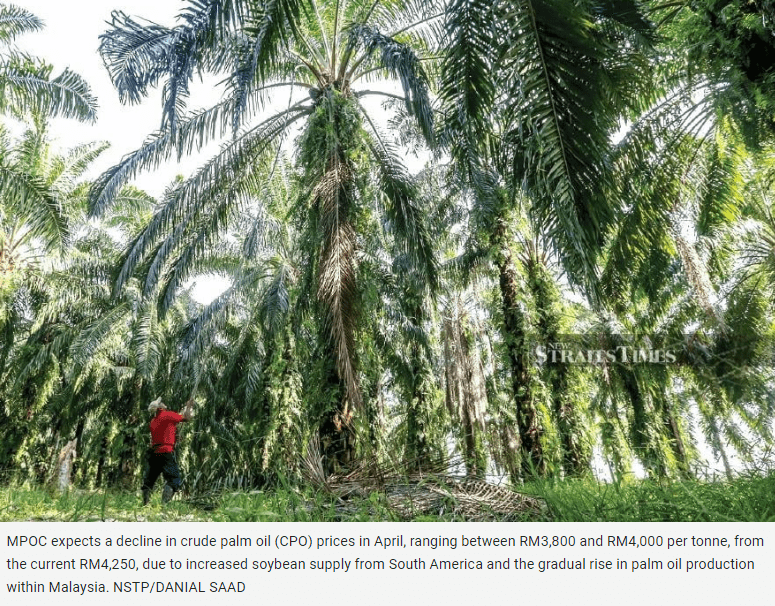
KUALA LUMPUR: Malaysian Palm Oil Council (MPOC) expects a decline in crude palm oil (CPO) prices in April, ranging between RM3,800 and RM4,000 per tonne, from the current RM4,250, due to increased soybean supply from South America and the gradual rise in palm oil production within Malaysia.
"Palm oil prices were trading at a premium of US$40 to US$95 per tonne above soft oils in March.Therefore, a recovery in soft oil prices is anticipated in April to narrow the price spread," said MPOC in a note today.
CPO prices surged to a 12-month high on March 15, climbing nearly 10 per cent above the February closing price.
MPOC attributes this strong price trend in the first quarter of 2024 to the deficit supply growth dynamic.
In February 2024, Malaysian palm oil stocks continued their downward trend, dropping by 5.0 per cent to 1.92 million tonnes, marking their lowest level since July 2023, primarily driven by reduced imports and robust domestic consumption.
MPOC reported a staggering 70 per cent year-on-year decrease in Malaysian palm oil imports in the first two months of 2024, plummeting to 0.062 million tonnes, which only accounted for 6.90 per cent of total imports in 2023.
Historically, Malaysian palm oil inventory heavily relied on imports for buildup. Hence, closely monitoring upcoming import figures is deemed crucial to gauge palm oil stock levels in Malaysia.
Strong domestic consumption also contributed to the decline in stocks, with January and February 2024 witnessing an 11.30 per cent growth compared to the same period in 2023.
MPOC said Malaysia's palm oil stocks will not see any growth in March, particularly during the Ramadan month and production is not expected to increase until April and beyond.
As the low season for palm oil production concludes in March, it sees that palm oil prices may begin to reflect the recovery in production and inventory levels in April and May, potentially capping palm oil prices.
Moreover, the price premium of palm oil over soft oils widened in March, surpassing the prices of three major soft oils concurrently since February in the European market.
Furthermore, the recent announcement by the Indonesian Palm Oil Association regarding Indonesia's palm oil inventory of 3.14 million tonnes as of December 2023 further indicated tight palm oil supply.
MPOC predicts that the combined palm oil stocks of Malaysia and Indonesia will be less than 5 million tonnes in February 2024.
In 2024, global palm oil production is expected to rise minimally by 0.11 per cent, while production growth for soybean oil, rapeseed oil and sunflower oil is projected to increase by 2.88 per cent, 3.48 per cent and 3.94 per cent respectively.
https://www.nst.com.my/business/corporate/2024/03/1027643/cpo-prices-fall-between-rm3800-rm4000-tonne-april-mpoc
Sumber : New Straits Times
- Details
- Hits: 656
PETALING JAYA: The plantation sector will likely see the impact of the hot and dry weather spell more towards the later part of 2024, but total production of the year will likely be higher year-on-year (y-o-y), helped greatly by the availability of adequate supply of labour to the sector.
Datuk Dr Ahmad Parveez Ghulam Kadir, director-general of the Malaysian Palm Oil Board (MPOB), told Starbiz the heat spell driven by the El Nino phenomenon became severe in the fourth quarter of last year (4Q23) and extended into 1Q24, adding that the impact of the weather phenomenon on oil palm yield is not immediate.
“The effect varies based on the severity of the event, with strong El Nino events often impacting yields significantly, while weak-to-mild events typically do not.
“The recent El Nino event, which strengthened at the end of 2023 and continued through early 2024, is considered strong and is expected to affect fresh fruit bunch (FFB) production by the end of 2024,” he said.
Despite that, crude palm oil (CPO) production is projected to continue to increase by 1.1% in 2024 to about 18.75 million tonnes, up from 18.55 million tonnes in 2023 and 18.45 million tonnes in 2022.
This growth in total production will be supported by the improvement in labour availability for the sector and better fertiliser application, he said.
Lower fertiliser prices compared to previous years have made it more affordable for farmers to apply the necessary nutrients to their crops, enhancing growth and yield.
“While weather conditions, particularly the ongoing effects of El Nino, will certainly influence production levels, the industry’s resilience and adaptive strategies play a crucial role.
“The combination of improved labour conditions and effective fertiliser use helps mitigate some of the adverse effects of El Nino, supporting a modest increase in production,” Ahmad Parveez explained.
Fundamentals for the sector remain strong. In May, CPO production hit 1.7 million tonnes, which was 13% higher month-on-month (m-o-m) and 12% higher y-o-y, which was above analysts’ expectation.
Ahmad Parveez said the improved labour situation ensures that harvesting and other crucial activities are conducted efficiently and on time, which is vital for maintaining and boosting CPO production.
Any negative weather impact was also neutralised partly by the lower fertiliser cost, which made it more feasible for planters to apply adequate amounts of fertilisers and are essential for the growth and yield of oil palms.
Better fertilisation application can help increase production, despite the challenges posed by the weather factor, he said.
Year-to-date, CPO production increased by 9.4% y-o-y to 7.26 million tonnes, offsetting the increases in exports that grew by 6.7% y-o-y to 6.3 million tonnes.
Production growth is set to continue. MIDF Research noted that although the mild El Nino peaked in April, the mixed dry-wet weather might be prolonged up to July, thereby improving estate activity ahead, particularly in terms of FFB evacuation processes and manuring activities.
The research firm expects CPO production to maintain its momentum in the remaining months, reaping the benefits of fertiliser application over the past two years.
RHB Research meanwhile stated with weather conditions having normalised since April to May in Indonesia, production in the world’s largest CPO producer should start to pick up in the coming months.
Indonesian planters continue to expect to see flattish-to-moderate output growth of 0-5% in 2024, it added.
From a CPO price perspective, the May MPOB data also showed exports for the month of 1.38 million tonnes were up 12% m-o-m and 28% higher y-o-y, which helped ensure stock levels growth saw a marginal increase to 1.75 million tonnes (up 1% m-o-m, 4% y-o-y) as increased domestic usage helped as well.
What’s important for planters is the palm oil exports are starting to show a rebound with destination markets seeking to shore up depleted edible oils stock levels.
The outlook for the April to June 2024 period suggests a rebound in imports by India, China and Pakistan, driven by the improved price competitiveness of palm oil after price rallies in competing vegetable oils like sunflower.
Indian importers are capitalising on the lower export prices available on the global market, following a significant reduction in its domestic stocks during 1Q24.
“This trend is expected to bolster India’s palm oil imports in the coming months. Similarly, China has begun to incrementally increase its imports of palm oil, soyoil and rapeseed oil to replenish its reduced stocks. This strategic move aims to stabilise the domestic market and ensure sufficient supply,” Ahmad Parveez said.
He believes that demand from these key markets will continue, thereby firming the price of CPO.
Furthermore, the current high crude oil prices at above US$80 a barrel are expected to further boost demand for palm oil, which in turn will support CPO prices.
Buyers may be having other ideas. Cargo surveyors Intertek and Amspec estimated palm oil exports for the first 10 days of
June had decreased by 20.4% and 21.6% m-o-m to 295,000 and 285,000 tonnes, respectively. This will likely pressure prices.
“We expect CPO prices to weaken over the next six-to-12 months on rising output. The key risk is a strong La Nina, which could affect global vegetable oil output and support prices. A mild La Nina could be positive for palm oil output, especially in Indonesia which has suffered due to El Nino last year.
“Indian buyers are price-sensitive and we think they may wait for prices to correct,” said Akash Gupta, director of credit research and analysis at Fitch Ratings.
TA Research noted Indonesia had implemented a reduction in palm oil export tariff in June, setting the reference price for CPO in June at US$778.82 per tonne, down from US$877.28 a tonne in May.
This adjustment would reduce the export tax for CPO to US$18 per tonne and the levy to US$75 a tonne, resulting in a reduction of export costs by US$49 per tonne compared to the previous month.
“We anticipate this may pose a threat to Malaysian palm oil exports, which are losing export competitiveness. If the production were to maintain its robust growth momentum, it would lead to resurgent palm oil stockpiles, which would potentially limit the CPO price increase,” the research house noted in a sector report.
It expects CPO prices in the coming months to be influenced by both palm oil production in Malaysia and Indonesia and weather patterns in the primary soybean-growing regions of Brazil and Argentina, where the La Nina weather could leave its mark the most.
TA Research added the US Department of Agriculture estimated global soybean production is set to hit a new record of 422.3 million tonnes, up some 25.3 million tonnes from 2023 and 2024 due to expanded planted acreage and average yield improvements.
Global soybean ending stocks for 2024 and 2025 are estimated at 128.5 million tonnes, up some 16.7 million tonnes from the previous year.
As such, MPOB anticipates firm CPO prices in 2024, ranging between RM3,900 and RM4,200 per tonne, helped by demand from key markets.
The benchmark three-months forward CPO futures contract on Bursa Malaysia Derivative yesterday last closed at RM3,930 a tonne, up RM14 for the day. CPO has been trading range bound between RM4,500 to RM3,500 in the past 23 months.
https://www.thestar.com.my/business/business-news/2024/06/12/cpo-production-projected-to-increase
Sumber : The Star